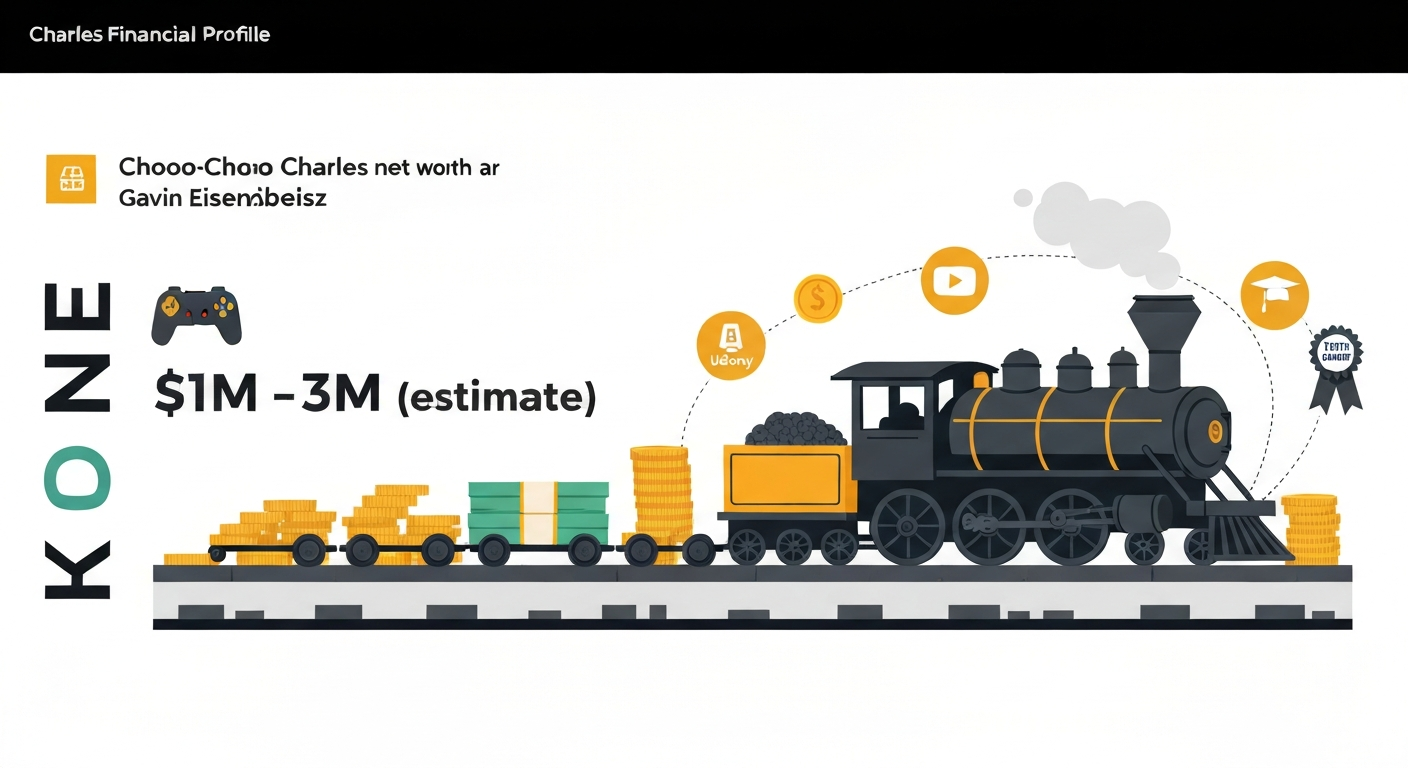
Choo-Choo Charles is not a person but a game, and the person behind it is Gavin Eisenbeisz, a solo developer who built and published the game under his studio name Two Star Games. As of mid-2026, Gavin's estimated net worth sits in the $1 million to $3 million range, driven primarily by Choo-Choo Charles game sales across Steam and consoles, YouTube channel revenue, and Udemy course income. That range reflects real uncertainty because Gavin has never publicly disclosed earnings, and the best available signals are third-party Steam owner estimates, public pricing data, and channel analytics.
Choo‑Choo Charles Net Worth 2026: Current Estimate & Breakdown

Marcus Rothwell
6 Aug 2026
Quick Net Worth Snapshot
Here is the clearest picture the available public data supports for Gavin Eisenbeisz (Choo-Choo Charles / Two Star Games) as of August 2026.
| Metric | Estimate / Range | Confidence |
|---|---|---|
| Current net worth (mid-point estimate) | ~$2 million | Low-to-medium |
| Net worth range | $1 million – $3 million | Moderate |
| Primary income driver | Choo-Choo Charles game sales (Steam + consoles) | High |
| Secondary income driver | YouTube channel (Two Star, ~530k subs) | Medium |
| Tertiary income driver | Udemy courses + other game catalogue | Medium |
| Epic MegaGrant (2022, undisclosed amount) | One-time non-recoupable grant | Confirmed |
| Public financial disclosures | None | N/A |
The $2 million mid-point is not a certified figure. It is a reasoned estimate built from unit-sales modeling, publicly listed prices, platform revenue-share assumptions, and YouTube analytics. The sections below explain each component in detail so you can calibrate your own view.
Who Is Choo-Choo Charles? Biography and Career Summary
Gavin Eisenbeisz was approximately 20 years old when Choo-Choo Charles launched on December 9, 2022, making him one of the more notable young solo developers to break through in recent indie gaming history. He developed the game under the studio name Two Star Games, handling design, programming, and art largely on his own. Two Star Games, itch.io developer page lists the studio's developer profile and catalogue, confirming the studio name and multiple published items Two Star Games — itch.io developer page. The premise of Choo-Choo Charles, a survival-horror game featuring a murderous spider-train creature on a open-world island, was deliberately absurdist and highly streamable, which turned out to be a key commercial asset. PC Gamer interviewed Eisenbeisz shortly after launch and noted that the attention around the release caught him somewhat off guard.
Before Choo-Choo Charles, Eisenbeisz was building experience in Unreal Engine and documenting that process on his YouTube channel (Two Star / @TwoStarGames). The channel accumulated subscribers through devlog content, game trailers, and tutorial-style videos, establishing an audience before the game even shipped. That pre-launch community building is a meaningful part of the financial story: it seeded the viral-streaming moment the game had at launch, when major YouTubers and Twitch streamers picked it up en masse in December 2022 and January 2023.
Two Star Games LLC is the published legal name used on console storefronts, including the Nintendo Switch eShop listing. Console releases followed the PC launch: PlayStation and Xbox versions released on December 21, 2023, and the Nintendo Switch version on January 18, 2024. This multi-platform rollout extended the game's commercial runway well beyond the initial PC launch window. Eisenbeisz also teaches on Udemy, with at least one listed course on Unreal Engine 5 that has enrolled thousands of students, adding a small but ongoing instructional income stream alongside his game catalogue on both itch.io and Steam.
Where the Money Comes From: Income Sources and Estimated Earnings
Game Sales on Steam
Steam is the dominant revenue channel. SteamSpy estimates Choo-Choo Charles owners in the 500,000 to 1,000,000 range as of mid-2026, though those figures are extrapolations from sample data and not audited numbers. The game's list price on Steam is $19.99, but SteamDB's price history shows periodic discounts, so a realistic average realized price per unit is probably closer to $13 to $16 after factoring in sales periods. Steam takes a 30% cut of revenue for smaller publishers (dropping to 25% after $10 million in sales and 20% after $50 million, thresholds this title almost certainly has not crossed). Applying these assumptions across a conservative and an optimistic scenario gives the following range.
| Scenario | Estimated Steam Units Sold | Avg. Realized Price | Gross Revenue | Steam Cut (30%) | Developer Net (Steam) |
|---|---|---|---|---|---|
| Conservative | 500,000 | $13.00 | $6,500,000 | $1,950,000 | $4,550,000 |
| Mid-point | 700,000 | $14.50 | $10,150,000 | $3,045,000 | $7,105,000 |
| Optimistic | 1,000,000 | $16.00 | $16,000,000 | $4,800,000 | $11,200,000 |
Those are gross developer receipts before taxes, living expenses, development costs (software, hardware, contractor fees), marketing, and any platform promotional commitments. On a net personal wealth basis, the amount retained is substantially lower. Assuming a rough effective tax rate in the 25 to 30 percent range on business income after deductible expenses, and factoring in ongoing costs of running a one-person studio, the personal net accumulation from Steam alone is likely in the $2 million to $6 million range across the full lifetime of the game, heavily weighted toward the conservative end given the uncertainty in unit estimates.
Console Sales (PlayStation, Xbox, Nintendo Switch)
Console storefronts (PlayStation Store, Microsoft Store, Nintendo eShop) each take platform cuts similar to Steam, typically 30%. Console versions launched more than a year after the PC version, so they benefited from residual brand awareness rather than the peak launch buzz. Console sales volumes for indie titles at this price point ($19.99 or regional equivalent) are generally smaller than Steam for a game with this profile, but the Nintendo Switch audience in particular tends to have good conversion for horror-adjacent titles. A reasonable estimate for combined console unit sales is 50,000 to 150,000 across all three platforms, adding perhaps $400,000 to $1.4 million in gross revenue before platform cuts.
YouTube Channel Revenue
The Two Star YouTube channel sits at roughly 530,000 subscribers with approximately 71 million lifetime views, according to SocialBlade snapshots. At industry-typical CPM ranges for gaming content ($2 to $5 per thousand monetizable views), and assuming a monetization rate of roughly 40 to 60 percent of total views (accounting for ad-blocked views, age-gated content, geographic variation), the channel's lifetime YouTube ad revenue is plausibly in the $60,000 to $200,000 range. Ongoing monthly channel revenue at current traffic levels is modest, likely in the $500 to $2,000 per month range unless major new content drives spikes.
Udemy Courses and Tutorials
Gavin Eisenbeisz has at least one Udemy course (Unreal Engine 5: Learn to Make a Professional Main Menu) with thousands of enrolled students. Udemy course pricing varies significantly with promotions, but instructor revenue per enrollment on organic/promotional sales typically ranges from $3 to $10 after Udemy's cut. At, say, 5,000 to 15,000 students and $5 average instructor revenue, that course alone may have generated $25,000 to $75,000. This is a relatively small but recurring and low-maintenance stream.
Epic MegaGrant
Epic publicly listed Gavin Eisenbeisz and Choo-Choo Charles as a 2022 MegaGrant recipient. Epic MegaGrants are non-recoupable, meaning the developer does not owe Epic a portion of future revenue. Epic does not publicly disclose individual grant amounts, but publicly reported MegaGrant awards have ranged from $5,000 to $500,000 depending on the project scope and stage. For an indie solo project at the stage Choo-Choo Charles was in during 2022, a grant in the $25,000 to $100,000 range is a plausible estimate, though that figure is genuinely unverifiable.
Merchandise, Endorsements, and Other Income
There is no confirmed evidence of a standalone merchandise line, sponsorship deals, or brand endorsements as of mid-2026. Some creator-focused indie developers sell merchandise through print-on-demand platforms, but Two Star Games does not appear to have a publicized storefront for that. Any such income, if it exists, is likely a minor contributor.
| Income Source | Estimated Lifetime Total (Pre-Tax) | Confidence Level |
|---|---|---|
| Steam game sales (Choo-Choo Charles) | $4.5M – $11.2M gross; ~$2M–$5M net to developer | Low-Medium |
| Console game sales (PS/Xbox/Switch) | $280K – $980K gross; ~$200K–$700K net | Low |
| YouTube ad revenue (Two Star channel) | $60K – $200K lifetime | Medium |
| Udemy courses | $25K – $75K lifetime | Medium |
| Epic MegaGrant (2022) | $25K – $100K (estimated range) | Low (amount undisclosed) |
| Other games / itch.io catalogue | Likely minimal (<$50K) | Low |
| Merchandise / endorsements | Unconfirmed, assumed negligible | Very Low |
Assets, Liabilities, and Notable Financial Events
Gavin Eisenbeisz has not made public statements about real estate holdings, investment portfolios, or significant liabilities. Given his age (mid-twenties as of 2026) and the timeline of his income, it is plausible that his primary assets are liquid cash, savings, or relatively simple investment accounts rather than property or complex business holdings. A solo indie developer generating income through a studio LLC would typically retain earnings in the business entity, pay personal salary or distributions, and potentially hold equipment and software licenses as business assets.
The most financially significant event in Two Star Games' history is the December 2022 launch of Choo-Choo Charles, which generated the vast majority of its lifetime revenue in the first two to four weeks. Steam launch-window revenue concentration is well-documented in the indie space: games typically earn 40 to 60 percent of their total lifetime Steam revenue in the first 30 days. The subsequent console launches in late 2023 and early 2024 represent secondary financial events that extended the earning curve.
The Epic MegaGrant in 2022 was a notable pre-launch financial event. It provided development runway without equity dilution or repayment obligations, which for a solo developer can be the difference between finishing and not finishing a project. No public record of debt financing, investor rounds, or publisher advances has been identified for Two Star Games, which suggests Eisenbeisz developed Choo-Choo Charles largely self-funded with the MegaGrant as external support.
No legal disputes, contract controversies, or publicized financial distress events have been identified in connection with Gavin Eisenbeisz or Two Star Games LLC as of mid-2026. There is no public evidence of significant personal liabilities such as mortgages or business loans, though absence of evidence is not evidence of absence.
Net Worth Growth Timeline
The following timeline maps the key milestones and their estimated impact on Gavin Eisenbeisz's net worth trajectory.
| Year / Period | Event / Milestone | Estimated Net Worth Impact | Cumulative Net Worth Range |
|---|---|---|---|
| Pre-2022 | Early game dev, YouTube devlogs, itch.io releases, Udemy course launch | Minimal income, brand building | <$50K |
| Early 2022 | Epic MegaGrant awarded to Choo-Choo Charles project | +$25K – $100K (est.) | $25K – $150K |
| Dec 9, 2022 | Choo-Choo Charles launches on Steam at $19.99; viral streamer adoption | +$1M – $4M gross launch-window | $500K – $2M (after taxes/costs) |
| Jan – Jun 2023 | Post-launch Steam long tail; YouTube channel growth accelerates | +$300K – $800K gross | $700K – $2.5M |
| Late 2023 | Console release (PS/Xbox, Dec 21, 2023); continued Steam tail revenue | +$100K – $400K gross | $800K – $2.8M |
| Jan 2024 | Nintendo Switch release (Jan 18, 2024); eShop visibility bump | +$50K – $200K gross | $850K – $3M |
| 2024 – mid-2026 | Ongoing game sales tail, YouTube, Udemy, potential new projects | +$100K – $500K across period | $1M – $3M (est. current range) |
The clearest inflection point is December 2022. The viral streaming moment, driven by major gaming YouTubers and Twitch streamers picking up the game within days of launch, functioned as an enormous free marketing event. Choo-Choo Charles peaked at roughly 581 concurrent Steam players (according to SteamDB records), which is modest by AAA standards but very healthy for a $19.99 solo-developed horror title. The real commercial impact was in purchases, not concurrent players, and the SteamSpy owner estimates suggest that conversion from streaming views to purchases was strong.
How This Compares to Other Charles Profiles
Gavin Eisenbeisz occupies a very different wealth category than most of the finance and business Charles figures profiled on this site. His estimated $1 million to $3 million net worth puts him firmly in the independent creator and indie developer tier rather than the corporate executive or institutional investor bracket. For contrast, see the Charles Chi net worth profile for a corporate executive perspective. For another example from the 'Charles' series, see the Charles Hoogland net worth profile for a contrasting wealth trajectory. For comparison, figures like Charles Chao (former CEO of Weibo) and Charles Hoogland (consumer brands executive background) represent careers built over decades in large organizations with compensation structures involving salaries, stock options, and board-level roles. Similarly, Charles Ho and Charles Kim profiles on this site reflect wealth built through institutional channels rather than a single breakout consumer product.
What makes Gavin's profile interesting in a comparative context is the speed and concentration of wealth creation. Most of his estimated net worth was generated in a matter of weeks around a single product launch, at an age when most career-track professionals have not yet started accumulating meaningful savings. That pattern of concentrated, product-driven wealth creation is more common among software and gaming creators than in traditional industries, and it's a useful contrast to the slower, salary-and-equity accumulation paths visible in the Charles Kim Alpine or Charles Chi profiles documented elsewhere on this site. See the Charles Kim net worth profile for a contrasting example of wealth built through institutional channels.
How We Estimated These Figures: Methodology and Confidence
No verified public financial disclosure exists for Gavin Eisenbeisz or Two Star Games LLC. The estimates in this article are constructed from public signals using the following methodology.
- Steam owner estimates from SteamSpy (500K–1M range), treated as a range rather than a point estimate, with SteamSpy's own methodological caveats acknowledged. SteamSpy uses sampling and extrapolation, not direct Valve sales data.
- List price from the Steam store ($19.99) and discount history from SteamDB to estimate an average realized selling price per unit of $13–$16.
- Steam's published revenue-share structure (30% cut for publishers below $10M threshold) applied to gross revenue estimates.
- A tax/cost reduction factor of approximately 40–50% applied to gross developer receipts to estimate personal net wealth accumulation.
- YouTube earnings estimated using SocialBlade lifetime view counts (~71M views), a standard gaming CPM range ($2–$5 per thousand), and a conservative monetizable view rate of 40–60%.
- Udemy course enrollment data (thousands of students per public listing) combined with typical Udemy instructor revenue-per-enrollment ranges.
- Console sales estimated using a fraction of Steam sales volume typical for indie titles launching 12+ months after PC release.
- Epic MegaGrant amount estimated using publicly reported ranges from other disclosed grants; actual amount for this specific grant is not public.
- No public property records, investment disclosures, or business filings were identified that would allow direct asset verification.
The overall confidence level for the $1 million to $3 million range is low-to-medium. The floor is reasonably well-supported by even conservative unit-sales scenarios. The ceiling is harder to defend without knowing actual sales volumes, tax treatment, expense structures, or investment activity. If Gavin has reinvested earnings aggressively into new projects or has significant business expenses, the personal net figure could be toward the lower end of the range. If he has managed costs tightly and invested surplus cash, it could exceed the upper end. We will update this profile as new public data becomes available.
Explore More Charles Profiles and Stay Updated
If you found this breakdown useful, the profiles for Charles Chao, Charles Hoogland, Charles Ho, Charles Kim, Charles Kim Alpine, and Charles Chi on this site offer detailed net worth analyses across very different wealth-building paths. Whether you're comparing indie creator economics to corporate executive compensation or just curious about how different industries and career structures produce different levels of wealth, those profiles provide useful context alongside this one.
A few quick answers for readers who have specific questions about this profile: Choo-Choo Charles is the game, not the person. The developer is Gavin Eisenbeisz. His studio is Two Star Games LLC. The game launched December 9, 2022 on Steam at $19.99 and has since expanded to PlayStation, Xbox, and Nintendo Switch. All net worth figures here are estimates based on public data signals, not verified disclosures. If you have a data point we should incorporate into this estimate, the methodology section above is the right frame for evaluating it.
- Bookmark this page for updated estimates as new public data (sales milestones, interviews, platform disclosures) becomes available.
- Check the Charles Chao and Charles Hoogland profiles for examples of executive-track wealth building at a much larger scale.
- See the Charles Kim Alpine profile for another data point on how young or relatively early-career professionals accumulate wealth in competitive fields.
- Follow Two Star Games on YouTube (@TwoStarGames) to track whether Gavin Eisenbeisz announces new projects that could materially change his earning trajectory.
- Use the SteamSpy and SteamDB public tools cited in this article to check for updated owner estimates if you want to run your own revenue model.
FAQ
What is Choo‑Choo Charles's estimated net worth (evidence‑based)?
Based on public signals (Steam sales estimates, console releases, Epic MegaGrant, YouTube/teaching income), an evidence‑based estimated net worth range for Gavin Eisenbeisz / Two Star Games (the creator behind Choo‑Choo Charles) is roughly $1.0 million to $4.0 million USD. This range reflects conservative gross revenue extrapolations from third‑party owner estimates (SteamSpy range 500k–1M owners), discounted real‑world net income after platform fees, taxes, development costs, and early‑stage business liabilities, plus ancillary income (YouTube, Udemy, grants). Confidence: medium (range reflects uncertainty in unit sales, pricing, and undisclosed expenses).
Why is the net worth given as a range rather than a single number?
Key financial details (exact unit sales, revenue splits on console storefronts, tax and expense records, and grant amounts) are not publicly disclosed. Third‑party sources provide owner and view estimates (SteamSpy, SteamDB, SocialBlade) that require extrapolation and corrections for discounts, refunds, and platform fees. The range captures realistic best/worst cases given available data and known unknowns (e.g., undisclosed MegaGrant amount, operating liabilities).
What public data sources support this estimate?
Primary public sources used: Steam store metadata and review counts (for conservative purchase signals), SteamSpy owner‑range estimates, SteamDB/SteamCharts player and price history, Epic MegaGrants public recipient listing, Two Star/TwoStarGames YouTube and SocialBlade analytics, Udemy instructor course enrollment, and press interviews (PC Gamer) identifying Gavin Eisenbeisz as the solo dev. These form the evidentiary basis for revenue and income‑stream modeling. Confidence: medium‑high for existence of streams, medium for precise dollar totals.
What are the verifiable income sources for Choo‑Choo Charles and estimated contributions?
Primary verifiable income sources and rough relative contributions: - Game sales (PC/Steam + consoles + Switch): likely the largest source — estimated 60–85% of gross revenue. - YouTube monetization (Two Star devlogs/trailers): measurable via channel views/subscribers; estimated modest but material supplemental income (~5–15%). - Paid courses/tutorials (Udemy): recurring instructor revenue — a smaller but steady contributor (~3–8%). - Grants (Epic MegaGrant): one‑time non‑recoupable boost; amount undisclosed but materially supportive of development — treated as a positive irregular inflow. - Merchandise/merch partnerships & endorsements: possible but not a primary revenue line based on public signals. These percentage bands reflect modeled scenarios, not audited split.
How were game sales estimated from Steam and other storefront data?
Estimates used: SteamSpy owner‑range (500k–1M owners) as an upper‑bound sample, Steam store review counts (~15k purchaser reviews) as a conservative lower‑bound signal, SteamDB price and discount history to estimate realized average sale price, and typical platform revenue shares (Steam ~30%, console stores similar or slightly different plus platform certification costs). We modeled low/medium/high unit sale scenarios, applied average realized price after discounts, subtracted platform shares and estimated development/marketing costs to derive net revenue available to the developer/publisher. Results produce the primary portion of the net worth range. Method caveats: SteamSpy and review‑to‑owner conversion ratios vary, so uncertainty is significant.
What assets and liabilities are known or reasonably inferred?
Likely assets: - Intellectual property (Choo‑Choo Charles IP held by Two Star Games/Two Star Games LLC). - Cash/reserves from game and ancillary sales. - Digital assets: YouTube channel, Udemy course listings, game code and project assets. - Consoles/platform publisher listings and possible publishing agreements. Likely liabilities (inferred): - Development costs (contractors, engine/license costs, taxes). - Business operating expenses and possible equipment leases or loans if any. No public corporate filings were found showing large debts or major outside investments; liabilities are therefore modeled as typical small indie studio operating expenses rather than disclosed large obligations.
Next Article
Charles Ho Net Worth: Current Estimate, Sources & Timeline
Charles Ho net worth: verified estimate, asset breakdown, key milestones and sources (figures dated Jul 1, 2026)