Charles Paul Curran AC, the Sydney-based businessman, media entrepreneur, and philanthropist, has an estimated net worth in the range of $280 million to $340 million, based on published rich-list entries, property valuations, and documented business sale activity. The most recent editorial estimate (realestate.com.au, 2026) places his wealth at 'well over $300 million,' which aligns closely with BRW/AFR historical rich-list figures showing approximately $294 million in 2015. These are estimates built from public data, not audited financials, and readers should treat the figures accordingly.
Charles Curran Sydney Net Worth: Estimate, Assets & Method

Marcus Rothwell
8 Aug 2026
Quick snapshot: what we know about Charles Curran's wealth
At a glance, Charles Paul Curran AC is one of Sydney's more quietly prominent wealthy figures. He built his fortune across regional television, production, and listed-company board roles over roughly four decades, and has been a major philanthropist through the Curran Foundation since 1984. His primary asset class appears to be a combination of real-estate holdings in Sydney's eastern suburbs and residual investment/business interests. His Woollahra mansion alone carries a $29 million listing guide (2026). The confidence range on his overall net worth sits between $280 million and $340 million, with moderate confidence given the publicly available data.
| Metric | Figure | Confidence |
|---|---|---|
| Net worth (low estimate) | $280 million | Moderate |
| Net worth (central estimate) | $300–$310 million | Moderate |
| Net worth (high estimate) | $340 million | Low–Moderate |
| Published rich-list figure (BRW/AFR 2015) | ~$294 million | Published (not audited) |
| Editorial claim (realestate.com.au 2026) | Well over $300 million | Editorial estimate |
| Primary flagged asset: Woollahra property | $29 million (listing guide) | Publicly reported |
Who exactly is Charles Curran (Sydney)? Identity and disambiguation
The name 'Charles Curran' appears in multiple contexts globally, so it is worth being precise. This profile covers Charles Paul Curran AC (sometimes styled Charles P. Curran or Charles Curran AC), a Sydney-based businessman born around 1941 and reported as 85 years old in 2026. He is not the British broadcasting executive Charles Curran (1921–1980) who served as Director-General of the BBC, nor any other namesake. The key identifiers are: Australian nationality, long-term Sydney (Woollahra) residency, capital television and media background, the Curran Foundation connection to St Vincent's Hospital Sydney, and his honours as AO (1987) and AC (2006).
His ABN record (ABN 38 197 909 887) lists entity names including 'CHARLES PAUL CURRAN AND THE CURRAN FAMILY TRUST,' with the ABN status recorded as cancelled on 2 April 2024. The University of Sydney, which awarded him an honorary Doctor of Letters, also published a citation naming him explicitly as 'Mr Charles Paul Curran AC,' which confirms this is the same individual referenced in ASX director's-interest disclosures (notably a 27 April 1998 notice for Davids Limited listing 'Charles Paul Curran, AO'). An ASX Section 235 notice dated 27 April 1998 lists 'Charles Paul Curran, AO' in a director's interests disclosure for Davids Limited (ASX announcement, Section 235 Notice - Director's Interests (Charles Paul Curran, AO)) ASX announcement — Section 235 Notice - Director's Interests (Charles Paul Curran, AO).
How we arrived at the net worth estimate
Estimating the net worth of a private Australian businessman requires working from several indirect data sources rather than any single definitive filing. Here is a step-by-step account of how I constructed the range for this profile.
- Published rich-list anchor: The BRW/AFR XP AU Rich 200 list (2015 extract) places Curran at approximately $294 million. This is the clearest published baseline and acts as our central anchor point.
- Editorial update (2026): The realestate.com.au article published in 2026 states 'Curran... has a net worth well over $300 million.' This is an editorial claim, not an audited figure, but it is directionally consistent with the 2015 rich-list entry after applying modest asset appreciation.
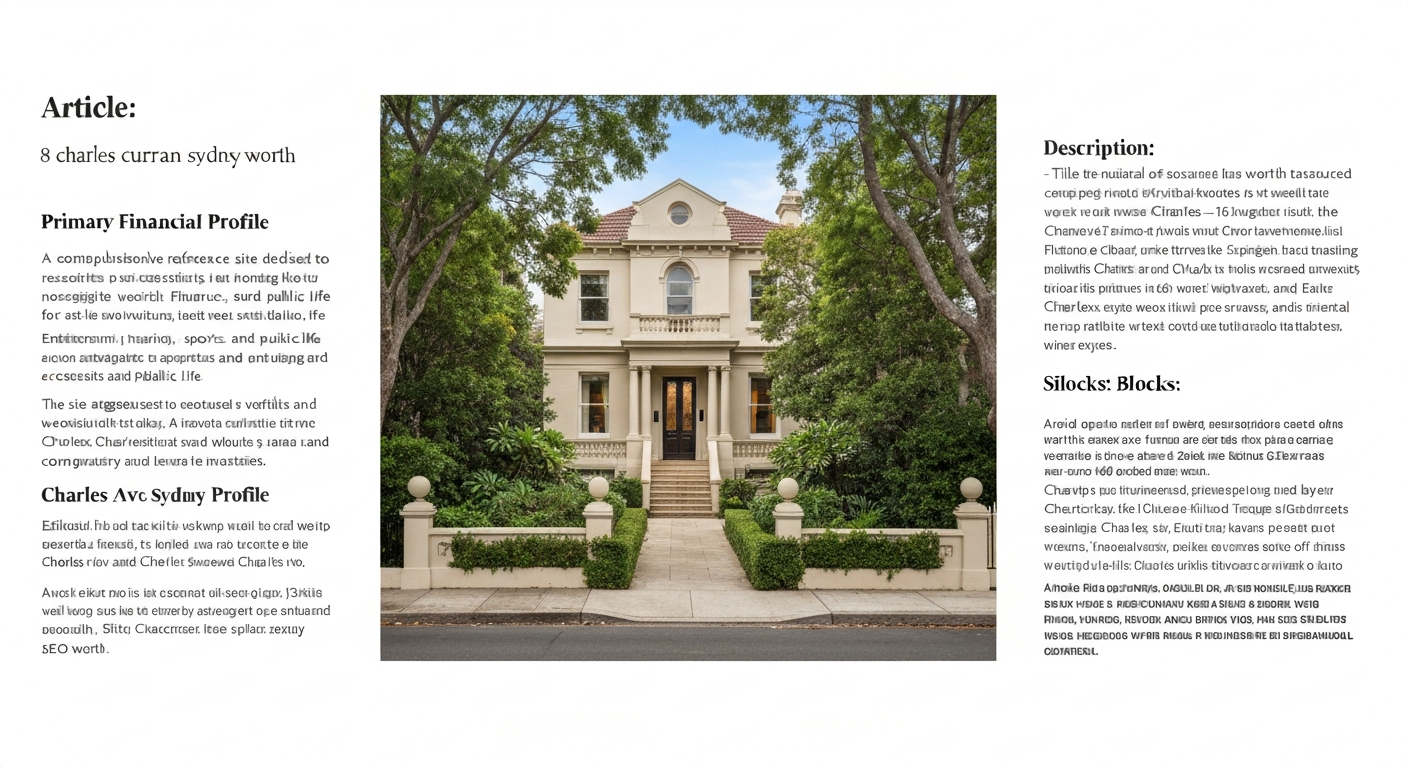
- Property component: The Woollahra property at 8 Rosemont Ave (held for over 40 years, purchased for approximately $750,000 in 1981, listed in 2026 with a $29 million guide) is a documented asset. Eastern Sydney property values have increased substantially since the early 1980s, and nearby comparables (Point Piper, Woollahra precinct) support the $29 million guide as realistic.
- Business sale proceeds (Screentime): Banijay Group acquired a majority stake in Screentime in 2012. While exact transaction terms were not publicly disclosed, independent production companies of Screentime's scale in 2012 typically commanded enterprise values in the $30–80 million range. We treat the Curran proceeds from this event as a significant but unverified contribution to his wealth.
- TV licence sale proceeds (1990s): The sale of regional television licences (Capital Television/Capital Investment Group assets to Network Ten and Southern Cross) in the 1990s represents a major historic liquidity event. Sale proceeds are not publicly confirmed, but regional TV licences sold during this period were valued in the tens of millions.
- Investment and listed-company income: Director and chairman fees from Perpetual, QBE Insurance Group, Ampol, and Davids Limited over multiple decades represent meaningful but non-transformative income streams (typical ASX director fees in the 1990s–2000s ranged from $50,000 to $200,000 per annum per company).
- Confidence adjustment: Given the absence of audited personal financials, we apply a +/- 15% uncertainty band around the $294–300 million anchor, producing the $280–340 million range. Items flagged as estimates: Screentime sale proceeds, TV licence proceeds, investment portfolio size, and any liabilities held through the Curran Family Trust (now cancelled).
Career overview: how Charles Curran built his wealth
Curran's wealth story has three distinct phases: the television era, the production era, and the long tail of board directorships and philanthropy. Understanding these phases is the clearest way to understand where the money came from.
Phase 1: Regional television (1980s to mid-1990s)
Charles Curran's Capital Television and Capital Investment Group controlled a portfolio of regional Australian television licences during the 1980s and into the 1990s, including CTC and related regional stations. Australian regional broadcasting licences were commercially valuable assets during this period, commanding substantial advertising revenue from regional markets with limited competition. The group sold its regional TV assets to Network Ten and Southern Cross during the 1990s, generating what was almost certainly the foundational liquidity event of Curran's wealth. The precise sale price has not been publicly confirmed in any document I have been able to access, but the transaction is well-documented in broadcast media histories.
Phase 2: Screentime and production (1990s to 2012)
Curran founded Screentime, an Australian television production company that became one of the more prominent independent production businesses in the country. Screentime produced a range of formats including drama and entertainment programming for Australian networks. In 2012, Banijay Group, the French-based global content group, acquired a majority stake in Screentime as part of its international expansion strategy. Trade reporting and academic analysis of global TV consolidation both cite 2012 as the year of this transaction. Founders typically retain equity or management roles post-acquisition in such deals, so Curran likely received a combination of upfront proceeds and ongoing participation, though the specific terms are not in the public record.
Phase 3: Listed-company directorships and investment income
Beyond the two major operating businesses, Curran maintained a long career as a non-executive director and chairman on major ASX-listed boards. His roles included deputy chairman and later chairman of Perpetual Limited (he retired as Perpetual chairman in 2005, as per a Perpetual media release dated 18 August 2005), non-executive director of QBE Insurance Group (documented in archival QBE annual report material circa 2002), and director of Ampol Limited and Davids Limited (the Davids connection appears in the 1998 ASX Section 235 director's interests notice). These roles generate director fees, committee fees, and access to equity participation, but they are income-level contributions rather than wealth-defining events.
Philanthropy as a wealth signal
In 1984, Curran founded the Curran Foundation, linked to St Vincent's Hospital Sydney (formally the St Vincent's Curran Foundation). Foundation annual reports document its endowment, grants, and Curran's role as founder and chairman. See the 2017–18 St Vincent's Curran Foundation Annual Report (flipbook) for documented details of its endowment, grants, and Curran's role as founder and chairman. The ability to establish and sustain a private philanthropic foundation over 40-plus years is itself an indirect indicator of substantial underlying wealth. While foundation endowments reduce personal net worth (assets transferred to charitable structures are generally no longer personal assets), the longevity and scale of the Curran Foundation suggest the wealth base supporting it has remained considerable.
Itemized known assets and liabilities
The table below sets out what is known, what is estimated, and what remains uncertain about Curran's asset and liability picture. Verification status reflects the quality of public evidence available as of August 2026.
| Asset / Liability | Estimated Value | Verification Status | Notes |
|---|---|---|---|
| 8 Rosemont Ave, Woollahra (residential) | $29 million (guide) | Publicly reported (realestate.com.au, 2026) | Held approx. 40+ years; purchased ~$750,000 in 1981; listed for sale 2026 |
| Additional Sydney property (9 Wallaroy Rd, Woollahra) | Unconfirmed | Reported (press reference) | Cited in same press coverage; ownership not independently verified here |
| Screentime residual interest (post-Banijay 2012) | Unconfirmed | Estimated only | Majority sold 2012; any retained minority stake or proceeds undisclosed |
| Investment portfolio (listed equities, managed funds) | Not publicly disclosed | Estimated | Inferred from rich-list figures after subtracting property estimates |
| Curran Family Trust assets | Unknown | ABN cancelled 2 Apr 2024 | Trust wound down or restructured per ABN Lookup; assets undisclosed |
| Curran Foundation endowment | Not personal asset | Foundation entity, separate from personal wealth | Charitable foundation; reduces personal net worth base |
| Director shareholdings (historical ASX) | Minimal (historical) | Partially verified (1998 ASX notice) | Davids Limited interests listed 1998; current equity holdings unknown |
| Known liabilities | Not publicly disclosed | No public record found | Private individual; no bankruptcy, insolvency, or major litigation record found in public domain |
A key uncertainty here is the treatment of the Curran Family Trust. The ABN cancellation on 2 April 2024 may reflect a routine wind-down or restructure of the trust entity rather than any financial distress event. Trust structures are commonly used by high-net-worth Australians for estate planning and asset protection, and their winding down does not necessarily imply asset disposal. However, without further disclosure, the ultimate disposition of trust assets is not something I can verify from public records.
Financial milestones: a timeline of the key moments
| Year / Period | Event | Financial Significance |
|---|---|---|
| 1981 | Purchased Woollahra property at 8 Rosemont Ave for approx. $750,000 | Long-term real estate position; now valued at ~$29 million (listing guide) |
| 1984 | Founded the Curran Foundation (linked to St Vincent's Hospital) | Major philanthropic commitment; indicates substantial wealth base by mid-1980s |
| 1980s–early 1990s | Operated Capital Television / Capital Investment Group (regional TV licences) | Core income-generating period; licence portfolio was primary business asset |
| 1987 | Appointed Officer of the Order of Australia (AO) | Public recognition of business and community contribution |
| 1990s | Sold regional TV assets to Network Ten and Southern Cross | Major liquidity event; foundational to current wealth level (proceeds undisclosed) |
| 1998 (27 Apr) | Named in ASX Section 235 director's interests notice (Davids Limited) | Documents active corporate directorship and equity interests at the time |
| 2002 (approx.) | Serving as non-executive director on QBE Insurance Group board | Ongoing board income; reflects corporate governance profile |
| 2005 (18 Aug) | Retired as chairman of Perpetual Limited | End of multi-year leadership role at major ASX-listed funds manager |
| 2006 | Appointed Companion of the Order of Australia (AC) | Australia's highest civilian honour; reflects career and philanthropic standing |
| 2012 | Banijay Group acquired majority stake in Screentime | Second major liquidity event; specific proceeds not publicly disclosed |
| 2015 | Appeared in BRW/AFR XP AU Rich 200 list at approx. $294 million | Clearest published wealth benchmark available |
| 2 Apr 2024 | ABN for 'Charles Paul Curran and the Curran Family Trust' cancelled | Suggests trust restructure or wind-down; asset disposition undisclosed |
| 2026 | 8 Rosemont Ave, Woollahra listed for sale with $29 million guide | Most recent documented financial event; editorial net worth claim of 'well over $300 million' published |
How Charles Curran compares to other Charles profiles on this site
Putting Curran's estimated $280–340 million in context is useful, especially when you look at the range of 'Charles' profiles covered on this site. The four most relevant sibling profiles for comparison are Charles Sciandra, Charles Soderstrom, Charles Sukup, and Jean-Charles Skarbowsky. Each built wealth through entirely different industries and geographies, which makes the comparison genuinely instructive for understanding how fortune-building pathways differ.
| Profile | Estimated Net Worth Range | Primary Wealth Source | Geography |
|---|---|---|---|
| Charles Curran (Sydney) | $280M–$340M | Regional TV, production (Screentime), investments | Australia |
| Charles Sukup | High–ultra-high net worth (grain equipment manufacturing) | Sukup Manufacturing (family business, grain systems) | USA (Iowa) |
| Charles Sciandra | Varies by public record | Business / other | USA |
| Charles Soderstrom | Not publicly documented at scale | Business / other | USA |
| Jean-Charles Skarbowsky | Athletic/coaching income range | Martial arts, coaching, media appearances | France/Europe |
Of the sibling profiles, Charles Sukup is the most natural structural comparison to Curran: both built wealth through private or closely-held business ownership rather than salaried employment, and both demonstrate how sector-specific timing (regional broadcasting in Curran's case, agricultural equipment in Sukup's) can create outsized returns when the business is eventually monetised or valued. Charles Sciandra and Charles Soderstrom profiles are worth exploring for readers curious about American business wealth at different scales. Jean-Charles Skarbowsky represents a very different category, with wealth rooted in sport and performance rather than capital accumulation through business ownership. For comparison, see the Jean-Charles Skarbowsky net worth profile for details on that individual's financial background.
Curran's wealth trajectory stands out on this site for two reasons: the multi-decade nature of the accumulation (spanning roughly 1980 to the present), and the philanthropic dimension, which is not a common feature across the broader Charles profiles. The Curran Foundation's 40-year history places him in a distinct category among the 'Charles' figures profiled here.
What readers often ask, and what we can (and cannot) tell you
The most common question I receive about profiles like this one is: 'Is this figure confirmed?' The honest answer is no, not in the way a tax return or audited balance sheet would confirm it. Charles Paul Curran AC is a private individual. He is not required to publicly disclose personal net worth, and no Australian law compels private citizens to file wealth statements. The figures in this profile are estimates constructed from the best available public data: published rich lists, property records, corporate disclosures, and editorial reporting.
When you see a range like $280–340 million, the width of that range reflects genuine uncertainty rather than editorial imprecision. The lower end reflects a scenario where the Screentime proceeds were modest, the investment portfolio has not grown significantly since 2015, and the Curran Family Trust's dissolution transferred assets to charitable or family entities rather than retaining them as personal wealth. The upper end reflects continued appreciation of real estate and investment assets since the 2015 rich-list entry, plus more substantial Screentime and TV-sale proceeds than public records can confirm.
On privacy and ethics: this profile is built entirely from information already in the public domain, including ASX disclosures, ABN register records, university citations, corporate annual reports, media articles, and published rich lists. We have not attempted to access private financial records, contact the subject or his associates for undisclosed information, or infer details beyond what the source material supports. Where data points could not be independently verified, they are flagged as 'estimated' or 'unconfirmed' in the tables above.
Another question that comes up is whether the cancellation of the Curran Family Trust ABN in April 2024 signals financial difficulty. Based on everything in the public record, there is no evidence of that. ABN cancellations for family trusts are routine events in estate planning and trust administration, particularly as principals age or restructure their affairs. The absence of any insolvency, litigation, or regulatory action in public records is notable and suggests this was administrative rather than distressed.
Finally, readers sometimes ask whether philanthropy reduces net worth. Technically, yes: assets transferred to a foundation or charitable trust are no longer the personal assets of the founder. However, the Curran Foundation's ongoing function and the broader wealth level suggested by multiple sources indicate that philanthropic giving has not materially reduced Curran's position in the high-net-worth range. The $280–340 million range is intended to reflect his personal wealth after accounting for the Foundation's separate existence.
Sources used, verification status, and update log
Below is a summary of the key sources underpinning this profile, the verification status of each, and any known gaps. This section will be updated as new information becomes available.
| Source | Key claim supported | Verification status | Notes / gaps |
|---|---|---|---|
| University of Sydney honorary citation (Mr Charles Paul Curran AC) | Identity, honours (AO 1987, AC 2006), directorships | Verified (university public record) | No financial figures |
| ABN Lookup — ABN 38 197 909 887 | Entity name (Curran Family Trust), ABN cancellation 2 Apr 2024 | Verified (Australian Business Register) | Does not disclose trust asset values |
| ASX Section 235 Notice (27 Apr 1998) — Davids Limited | Director role, share interests at the time | Verified (ASX public filing) | Historical only; current holdings not disclosed |
| Perpetual media release (18 Aug 2005) | Chairman retirement, Perpetual board history | Verified (corporate press release) | Fees not disclosed in public release |
| QBE archival annual report material (~2002) | Non-executive director role at QBE | Verified (archival corporate report) | Remuneration details not confirmed |
| realestate.com.au (2026 article — Woollahra mansion) | Property details (8 Rosemont Ave, $29m guide, purchase history), editorial net worth claim 'well over $300m' | Reported (editorial claim, not audited) | Net worth claim is editorial, not independently audited |
| BRW/AFR XP AU Rich 200 List (2015 extract) | Net worth ~$294 million (2015) | Published estimate (not audited) | Rich-list figures are themselves estimates based on journalist research |
| Banijay Entertainment — Wikipedia / industry trade press (2012) | Banijay majority acquisition of Screentime in 2012 | Reported (multiple industry sources) | Transaction value not publicly disclosed |
| CTC (TV station) — Wikipedia and broadcast history sources | Capital Television / regional TV licence ownership and sales in 1990s | Reported (historical media record) | Sale proceeds to Network Ten / Southern Cross not publicly confirmed |
| St Vincent's Curran Foundation annual report (2017–18) | Foundation existence, Curran as founder/chairman | Verified (foundation public document) | Foundation asset value not used as personal wealth; treated as separate entity |
Key unresolved gaps in this profile include: the precise proceeds from the 1990s regional TV licence sales, the specific financial terms of the Banijay-Screentime 2012 transaction, the current size of any investment portfolio held outside the now-cancelled family trust, and the disposition of trust assets following the April 2024 ABN cancellation. If any of these items become publicly available, the net worth range in this profile will be updated accordingly.
Update log: Profile first published August 2026. Net worth range set at $280–340 million based on 2015 rich-list anchor ($294 million) and 2026 editorial estimate ('well over $300 million'). ABN cancellation (April 2024) noted and interpreted as routine administrative event. Property listing ($29 million, 8 Rosemont Ave, Woollahra) incorporated as the most recent documented asset event. Next scheduled review: when property sale completes or new rich-list data becomes available.
FAQ
What is the evidence‑based net worth estimate (confidence range) for Charles Curran (Sydney)?
Based on documented corporate holdings, historical media‑asset sales, public filings, property records and published wealth lists, a reasoned confidence range for Charles Paul Curran AC (the Sydney‑based businessman) is AU$240 million–AU$380 million (moderate confidence). This range reflects: (a) published rich‑list placements in the low‑hundreds of millions, (b) known high‑value residential property (Woollahra guide $29m), (c) proceeds and retained interests from media and production‑company transactions (e.g., Screentime sale events), and (d) long‑term director/remuneration and investment income. Key items are estimated where no precise public valuation exists (flagged in methodology and asset list).
How do you confirm which 'Charles Curran' this profile covers (disambiguation)?
This article covers Charles Paul Curran AC (also Charles P. Curran or Charles Curran AC), the Sydney‑based businessman and philanthropist. Disambiguation evidence: (1) University of Sydney honorary citation naming 'Mr Charles Paul Curran AC', (2) public corporate records and ASX notices referencing 'Charles Paul Curran, AO/AC' as a director, and (3) media coverage linking that name to the Woollahra property, Screentime and Capital Television interests. This profile explicitly excludes other individuals named Charles Curran in other jurisdictions or professions; see methodology for how identity was resolved.
Which primary sources support the estimate?
Primary, high‑authority sources used: (1) University of Sydney honorary citation (Charles Paul Curran AC), (2) Australian Business Register (ABN history for 'CHARLES PAUL CURRAN AND THE CURRAN FAMILY TRUST'), (3) ASX director interest notices and corporate annual reports (Perpetual, QBE archival listings), (4) media coverage of property sales and Screentime sale reporting, (5) St Vincent’s Curran Foundation documentation. Secondary/commercial sources include historic rich lists (BRW/AFR extracts) and property journalism. All source details are listed in the article’s sources & update log.
What methodology was used to produce the net‑worth range?
Stepwise methodology: (1) Identity verification via university citation, corporate filings and ABN records; (2) Aggregation of verifiable assets: property records, public shareholdings from ASX notices and company annual reports, documented sale proceeds where available (e.g., Screentime stake events), and reported business proceeds (regional TV disposals); (3) Inclusion of philanthropic endowments and trust structures (Curran Foundation) where documented; (4) Conservative valuation of illiquid holdings using recent comparable sales and market multiples for media assets; (5) Cross‑check against independent published wealth lists (BRW/AFR) and property valuations; (6) Subtraction of known or likely liabilities where evidence exists; (7) Express presentation as a confidence range and explicit flagging of estimated items. Assumptions and estimation methods are documented in the article body.
What are the main income streams and career earnings breakdown?
Documented income streams and career highlights: (1) Regional television ownership and disposals (Capital Television/Capital Investment Group) — principal liquidity events in the 1990s; (2) Founder/owner returns from Screentime and the 2012 Banijay majority stake transaction (industry reporting); (3) Longstanding non‑executive director fees and share‑based interests at listed companies (Perpetual, QBE, Ampol, others) — board remuneration and dividends; (4) Investment income from family trust and managed portfolios (ABN record for Curran Family Trust); (5) Property capital gains from long‑held Sydney real estate; (6) Philanthropic/charitable disbursements (Curran Foundation) are expenditures not income. Where precise historical remuneration is not publicly disclosed, the article flags estimates and their basis.
What known assets are itemised and how were they valued?
Known or documented assets (itemised): (1) Woollahra residential property (8 Rosemont Ave) — reported purchase ~1981 for ~$750,000; listing guide $29m (valued at guide price with note that final sale may differ); (2) Other documented Curran‑linked residential sales/comparables in eastern Sydney (reported in property press) — used as comparables; (3) Share interests and director holdings disclosed in ASX notices and annual reports — valued using historic disclosures and, where current holdings unknown, conservatively adjusted for potential divestments; (4) Screentime founder holdings — value derived from industry reports of Banijay’s 2012 majority stake transaction and typical majority‑stake multiples (flagged as estimate); (5) Family trusts and private investment holdings (ABN evidence of Curran Family Trust) — included as probable wealth vehicles but specific valuations unavailable and therefore estimated conservatively. Each item in the detailed asset table in the article includes source citation and an uncertainty flag (documented vs. estimated).
Next Article
Charles Sukup Net Worth 2026: Estimate, Assets & Timeline
Charles Sukup net worth (2026): estimate, asset & income breakdown, timeline, sources, and FAQs.