
Charles Farrell's net worth at the time of his death in 1990 is not a matter of public record, but based on his documented career earnings, the 1959 sale of the Palm Springs Racquet Club for a reported $1.2 million, and his decades of real estate activity in the Coachella Valley, a reasonable working estimate places his estate in the range of $2 million to $5 million in 1990 dollars, roughly $5 million to $12 million in 2026 terms after inflation adjustment. That is an informed estimate, not a verified figure, and the distinction matters.
Charles Farrell Net Worth: Estimate, Sources & Career

Marcus Rothwell
13 Jul 2026
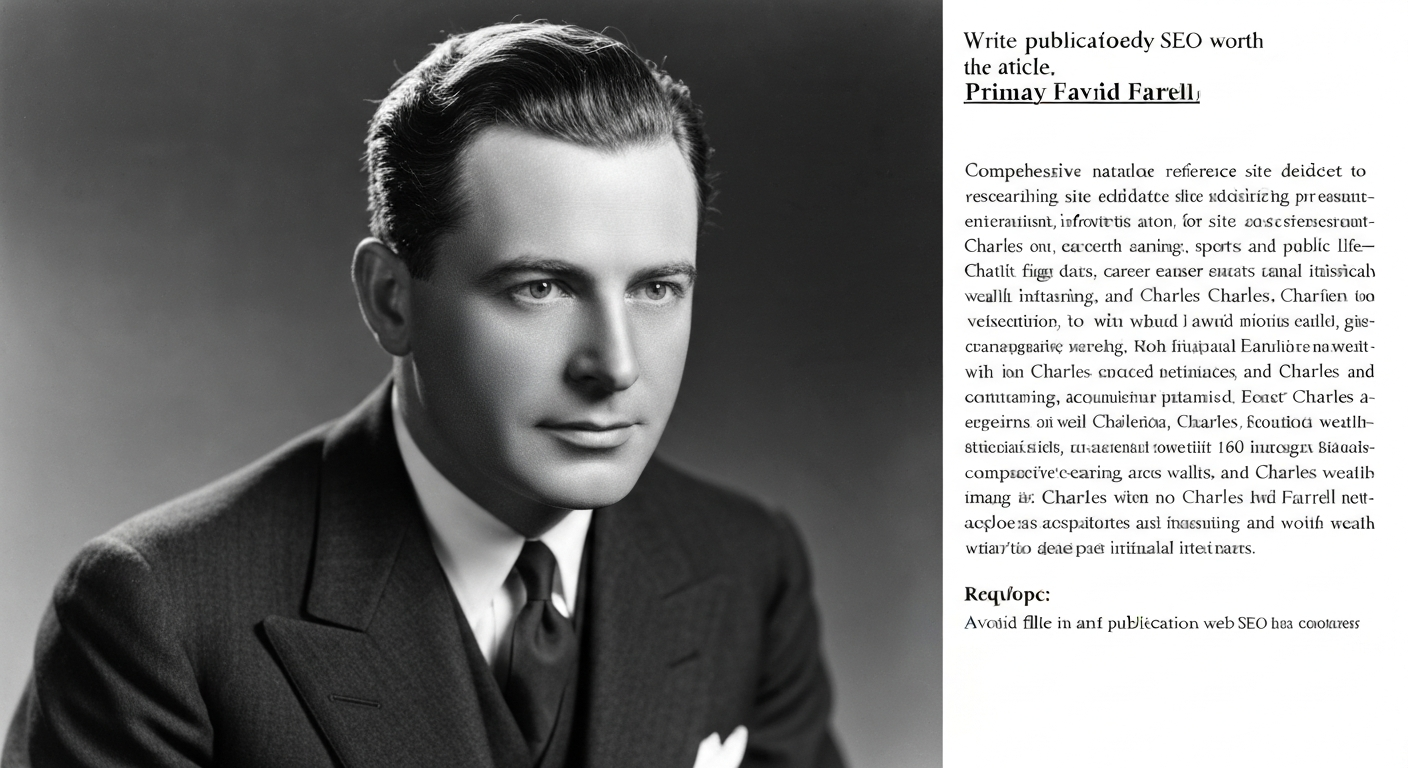
Quick answer: what was Charles Farrell worth?
Working estimate: $2 million to $5 million (1990 dollars) at time of death, equivalent to approximately $5 million to $12 million in mid-2026 dollars. Confidence level: low-to-moderate. No probate record, estate filing, or publicly reported net-worth figure has been located in available public sources. The range is constructed from documented income events, the single confirmed property transaction, and reasonable assumptions about career earnings during the silent-film era. Treat it as an informed floor-and-ceiling, not a certified number.
Which Charles Farrell are we talking about?
This article covers Charles David Farrell, born August 9, 1900, in Onset Bay, Massachusetts, and died May 6, 1990, in Palm Springs, California. He was a Hollywood actor best known as the romantic lead opposite Janet Gaynor in the 1927 silent classic Seventh Heaven, a co-founder of the Palm Springs Racquet Club, a Palm Springs real estate developer, and the city's mayor from 1947 to 1955. He also appeared on 1950s television, including My Little Margie and The Charlie Farrell Show. This is the primary public figure associated with the name 'Charles Farrell' in entertainment and civic history contexts.
There is no significant contemporary public figure named Charles Farrell whose net worth is widely tracked in financial databases, so the historical figure is almost certainly who search queries are reaching for. If you arrived here looking for information on the Farquharson family, a separate but frequently confused group of names, see the clarifying section near the end of this article.
The verified estimate and what we actually know
Estimate date: July 2026, constructed from historical public records. The only hard financial figure in the public record is the reported $1.2 million sale price of the Palm Springs Racquet Club in 1959, cited consistently across Los Angeles Times coverage and city historical documents. No probate record, Screen Actors Guild pension documentation, tax filing, or estate inventory has surfaced in publicly accessible archives. The Los Angeles Times obituary published May 11, 1990, describes Farrell as an actor, developer, and former mayor but states no financial totals. The City of Palm Springs historic resources report similarly documents his activities without attaching dollar values to his personal estate.
Because no certified figure exists, this profile constructs a range rather than a single number. That is the honest approach. The $1.2 million Racquet Club sale alone, in 1959 dollars, is equivalent to roughly $12.5 million in 2026 dollars using standard CPI adjustment. Even if Farrell only retained a portion of that sale (he co-founded the club with Ralph Bellamy and operational costs and any liabilities would have reduced the net), it represents the most significant single documented wealth event of his career.
Sources, caveats, and why some figures are estimated
The primary sources used to construct this estimate include: the Los Angeles Times obituary (May 11, 1990), City of Palm Springs Citywide Historic Context Statement and Survey Findings, the Palm Springs Preservation Foundation's RCCW Historic District Nomination, the AFI Catalog of Feature Films, and IMDb credits documentation. Secondary sources include Palm Springs Life historical coverage of the Racquet Club.
- Silent-film era salaries (1920s): Actor contracts from the major studios of this period are not systematically digitized or publicly released. We know top-tier romantic leads at Fox Film Corporation could earn between $1,000 and $5,000 per week at peak; whether Farrell reached that ceiling is unconfirmed.
- The 1959 Racquet Club sale price of $1.2 million is the most reliably documented figure, appearing in multiple independent sources.
- Farrell's equity share in the Racquet Club at the time of sale is not specified in any public document reviewed. Co-founder Ralph Bellamy's stake and any later investors or partners are not detailed in available records.
- Post-sale real estate holdings: Farrell remained active in Palm Springs development after 1959, but specific property values, sale prices, or portfolio totals are not in publicly accessible records.
- Television earnings from My Little Margie and The Charlie Farrell Show (mid-1950s) are not documented in public contract records.
- No probate or estate filing has been found through standard public-records channels for Riverside County (where Palm Springs is located).
- Inflation adjustments in this article use the U.S. Bureau of Labor Statistics CPI calculator, applied from the transaction year to 2026.
Breaking down the income streams and major assets
Film earnings (1920s and 1930s)
Farrell's film career peaked during the late silent era and early sound period. Seventh Heaven (1927) was a major Fox Film Corporation production, and its success launched him as one of the studio's top romantic leads. See the AFI Catalog of Feature Films, American Film Institute for searchable entries on Seventh Heaven (1927) and other Charles Farrell film credits AFI Catalog of Feature Films — American Film Institute (searchable catalog; entries for Charles Farrell films). He and Janet Gaynor were paired in multiple follow-up productions, giving him sustained contract leverage through the early 1930s. At the heights of the studio system, a performer with his profile could negotiate weekly salaries that accumulated to tens of thousands of dollars per film. However, like many silent-era stars, his film career declined as talkies reshaped audience preferences, and by the late 1930s his screen work had tapered off. Residuals and royalties from silent-era films were essentially non-existent in the modern sense; studios retained all rights, and actors did not receive ongoing payments from theatrical re-releases or early television licensing at the levels contemporary performers do.
The Palm Springs Racquet Club (1933/34 to 1959)
This is the clearest wealth-building chapter in Farrell's financial story. He and Ralph Bellamy co-founded the Racquet Club in the early 1930s and developed it over roughly 25 years into one of the most famous celebrity resorts in California. The club attracted Hollywood's elite and became a genuine Palm Springs landmark. When Farrell sold it in 1959 for a reported $1.2 million, that transaction captured 25 years of appreciation in one of the most desirable resort markets in the American Southwest. At the time, $1.2 million was a substantial sum, comparable to major residential or commercial real estate deals in Los Angeles. In 2026 dollars, that figure is approximately $12.5 million.
Television work (1950s)
Farrell's television appearances, including a recurring role on My Little Margie and his own series The Charlie Farrell Show, would have generated meaningful income in the mid-1950s television market. Early television was not the windfall it would become for stars of later decades, and residual structures for 1950s television were far less favorable than today's agreements. These earnings likely provided steady income during his mayoral years but are unlikely to represent a major component of total lifetime wealth.
Real estate and Palm Springs development
Beyond the Racquet Club, Farrell's involvement in Palm Springs development across the 1940s and 1950s suggests he held additional property. City of Palm Springs historic documentation and preservation records position him as a meaningful civic and commercial actor in the city's growth, not simply a club owner. The nature and value of those holdings remain unverified in public records I have been able to review. His mayoral role from 1947 to 1955 also placed him at the center of decisions shaping Palm Springs land use during one of the desert city's most formative periods.
Known liabilities and deductions
No specific liabilities have been documented. However, operating a large resort property for 25-plus years would have involved ongoing costs, potential debt, payroll, and capital expenditure. Any co-ownership arrangements with Bellamy or later investors would have reduced Farrell's net proceeds from the 1959 sale. These factors are why the wealth estimate is expressed as a range rather than a point figure.
Career milestones and the money moments
| Year | Event | Financial significance | Confidence |
|---|---|---|---|
| 1925–1926 | Early Fox Film Corporation contracts | Entry-level to mid-tier studio salary; amount unconfirmed | Low |
| 1927 | Seventh Heaven released; major commercial success | Elevated contract leverage and salary; specific figure unknown | Moderate (career impact documented) |
| 1927–1934 | Sustained romantic-lead run at Fox with Janet Gaynor | Multiple top-billing contracts; peak earning years in film | Moderate |
| 1933/34 | Co-founds Palm Springs Racquet Club with Ralph Bellamy | Capital investment and ongoing operational income over 25+ years | High (event documented) |
| 1947 | Elected Mayor of Palm Springs | Civic role; no direct financial payment of significance | High |
| 1947–1955 | Serves as Mayor of Palm Springs | Mayoral salary modest; primary financial activity remains real estate/club | High |
| 1952–1955 | Television: My Little Margie and The Charlie Farrell Show | Mid-1950s TV fees; supplemental income, not primary wealth source | Moderate |
| 1959 | Sells Palm Springs Racquet Club for reported $1.2 million | Single largest documented wealth event (~$12.5M in 2026 dollars) | High (price cited in multiple independent sources) |
| 1990 | Death at age 89 in Palm Springs | Estate value undocumented in public records | N/A |
How he compares to peers and historical equivalents
Comparing Farrell to contemporaries helps put the numbers in perspective. The silent-film era produced a small number of enormous fortunes (Charlie Chaplin, for example, became genuinely wealthy through ownership of his own films and later United Artists). Most contract players, even successful ones, were salaried employees of studios and did not retain rights to their work. By that standard, Farrell was unusually well positioned in later life because his wealth derived not from film royalties, which he had no meaningful claim to, but from a real business he built and sold.
A useful comparison set includes other studio-era actors who transitioned into business or real estate. Gene Autry, who was roughly a generation behind Farrell, built a substantial fortune through radio, television, and especially real estate and franchise ownership, eventually reaching the hundreds-of-millions range. That is a very different scale. A closer peer in structure, though not fame, might be actors of the 1930s and 1940s who invested early in California real estate at pre-boom prices and benefited from the post-war appreciation wave. In that cohort, a final estate in the low-to-mid millions by 1990 would not be unusual.
In terms of the Racquet Club transaction specifically, $1.2 million in 1959 was roughly equivalent to the price of 10 to 15 average California homes at the time. As a resort sale, it was substantial but not extraordinary for a well-established commercial property. The real story is not one number but 25 years of operational cash flow from one of Palm Springs's premier venues, which would have produced ongoing income not captured in the headline sale price.
Legacy earnings and how the estate holds up over time
Unlike performers who built wealth through intellectual property ownership, Farrell's estate would not have generated meaningful ongoing royalties after his death. Silent-era and early-sound films were studio-owned, and the licensing revenue from those titles flows to the studios (later to Fox/Disney successors), not to actor estates. Television residuals from 1950s programming, where they existed at all, were minimal. His financial legacy is therefore primarily a function of how his real estate and investment holdings were managed after the Racquet Club sale, a question the public record does not answer.
From a legacy standpoint, the Palm Springs Racquet Club itself outlasted Farrell's ownership and remains a historically significant property in Palm Springs, documented by the Palm Springs Preservation Foundation and the city's historic resources program. The club's cultural significance, as a gathering point for mid-century Hollywood, adds to Farrell's historical profile without adding to his estate. Cultural capital and financial capital are different ledgers.
Common questions and quick clarifications
A few questions come up reliably when readers search this topic, so here are direct answers.
- Was Charles Farrell a millionaire? Almost certainly yes, at least in nominal terms, given the 1959 Racquet Club sale alone. Whether he died a millionaire in 1990 depends on how his assets were managed and spent across 31 years post-sale, which is undocumented.
- Did he earn money from Seventh Heaven reruns or streaming? No. Rights to the film rest with the studio successor (ultimately Disney/Fox), not the Farrell estate. Silent-film performers were not contracted for residuals.
- Is there a publicly available estate figure? Not in any source reviewed for this article. No probate record or estate filing has been located.
- Did Ralph Bellamy's estate include Racquet Club proceeds? Bellamy had a separate financial history. The two men co-founded the club, but their relative ownership stakes and payout at the 1959 sale are not detailed in available records.
- Was Farrell wealthy from his acting career alone? Unlikely to the degree his real estate activity provided. Studio salaries of the era were paid out and spent; they did not compound. The Racquet Club was his most durable asset.
A note on similarly named subjects: the Farquharson profiles
Readers landing on this page sometimes arrive while searching for net worth information on individuals with similar-sounding names, particularly those connected to the Farquharson family. Charles and Catherine Farquharson, the Charles Farquharson family more broadly, and Charles Farquharson of London are distinct subjects with their own separate financial profiles on this site. For details on the Farquharson family's finances, see the separate profile on Charles Farquharson family net worth. They are not the same person as Charles David Farrell, the actor and Palm Springs developer discussed here. The naming overlap is a source of search confusion, and it is worth being explicit: Farrell and Farquharson are different surnames and different individuals. If your search is actually about the Farquharson family's wealth, those dedicated profiles cover that ground with their own sourcing and estimates. If your search is actually about the Farquharson family's wealth, see the separate Charles and Catherine Farquharson net worth profile for their dedicated financial coverage. For details on Charles Farquharson of London, including net worth estimates, see the separate Charles Farquharson profile on this site Charles Farquharson (London) net worth.
How to verify these figures yourself
If you want to dig into the primary record and check or improve on the estimates here, these are the most productive avenues.
- Riverside County Assessor and Recorder: Property records for Palm Springs are held by Riverside County. Deed transfers, sale prices, and ownership history for Racquet Club parcels and other Farrell properties can be searched through the county recorder's office or its online portal.
- Riverside County Superior Court Probate Records: If Farrell's estate went through California probate (as most estates of that size would have in 1990), the probate file would be on record at the Riverside County courthouse. Probate inventories list assets and values at time of death.
- Los Angeles Times Historical Archive: The May 11, 1990 obituary is the baseline document. The Times archive (available through many public libraries via ProQuest) may contain earlier coverage of the Racquet Club sale and other financial events.
- AFI Catalog of Feature Films: For film credits and production context, the American Film Institute's catalog is authoritative and freely searchable online.
- Palm Springs Historical Society and Palm Springs Preservation Foundation: Both organizations hold local archives including documents on the Racquet Club's history, ownership records, and Farrell's civic activities.
- U.S. Bureau of Labor Statistics CPI Inflation Calculator: For your own inflation adjustments from 1927, 1959, or 1990 to present, the BLS calculator at bls.gov/data/inflation_calculator.htm is the standard tool.
- Screen Actors Guild-AFTRA (SAG-AFTRA) historical records: SAG may hold historical contract summaries or membership records for performers of Farrell's era, though access for researchers varies.
Suggested images and captions
- Portrait photograph of Charles Farrell circa 1927–1930 (Fox Film Corporation publicity still): Caption suggestion: 'Charles Farrell at the height of his Fox Film career, shortly after the release of Seventh Heaven (1927).'
- Film still from Seventh Heaven (1927) featuring Farrell and Janet Gaynor: Caption suggestion: 'Charles Farrell and Janet Gaynor in Seventh Heaven — the film that established Farrell as one of Hollywood's top romantic leads and secured his peak studio salary.'
- Archival photograph of the Palm Springs Racquet Club exterior, circa 1940s–1950s: Caption suggestion: 'The Palm Springs Racquet Club, co-founded by Farrell and Ralph Bellamy in the early 1930s and sold in 1959 for a reported $1.2 million — the single largest documented financial event in Farrell's career.'
- Palm Springs city hall or mayoral records image: Caption suggestion: 'Farrell served as Mayor of Palm Springs from 1947 to 1955, a period that overlapped with his ownership of the Racquet Club and active real estate development in the city.'
- Newspaper clipping or scan of the Los Angeles Times May 11, 1990 obituary (if rights permit): Caption suggestion: 'The Los Angeles Times obituary describing Farrell as actor, developer, and former Palm Springs mayor — the primary public document summarizing his career but providing no estate valuation.'
The bottom line on Charles Farrell's net worth
Charles David Farrell built his wealth not through royalties or passive film income but through a deliberate pivot from acting to real estate and hospitality, anchored by 25 years of ownership of the Palm Springs Racquet Club. The $1.2 million sale of that club in 1959, worth approximately $12.5 million in 2026 dollars, is the clearest financial milestone in the public record. His broader estate at death in 1990 is unverified, but a working estimate of $2 million to $5 million in 1990 terms ($5 million to $12 million today) is consistent with the documented transaction history, reasonable assumptions about film-era earnings, and the absence of any significant ongoing royalty streams. No probate record, estate filing, or certified net-worth figure is publicly available, so that range should be read as a historically informed approximation rather than a confirmed figure. If you are researching separately named individuals in the Farquharson family, separate profiles on this site address their financial histories with dedicated sourcing.
FAQ
What is Charles Farrell’s net worth?
There is no publicly documented, authoritative final net‑worth figure or probate total for Charles David Farrell (1900–1990). Contemporary obituaries and municipal histories summarize his film, television and real‑estate activities but do not publish an overall net‑worth number. Available public records do allow a cautious, partial estimate of his known large transaction (the reported 1959 sale of the Palm Springs Racquet Club for about $1.2 million), but that sale alone is not sufficient to produce a definitive lifetime net‑worth figure. Sources: Los Angeles Times obituary (May 11, 1990); City of Palm Springs historic materials.
Why can’t you give a single definitive net‑worth number?
Definitive net worth requires contemporaneous, itemized financial records (tax returns, probate filings, estate inventories) or a reliable published valuation. Public secondary sources (newspapers, civic histories, film databases) document major transactions and career earnings in broad terms but do not disclose full asset lists, liabilities, or final estate valuations for Farrell. Histories cite his business activities (notably the Racquet Club sale) but stop short of reporting total personal wealth at death.
What are the primary income streams and major assets known for Charles Farrell?
Known income streams and assets: - Film acting fees and residuals (1920s–1930s lead roles, e.g., Seventh Heaven) — documented in film catalogs and credits (AFI Catalog). - Television work and appearances (1950s credits) — TV listings and databases (IMDb). - Real estate and hospitality business: co‑founder and long‑time owner of the Palm Springs Racquet Club (opened early 1930s); reported sale in 1959 for about $1.2 million. - Civic positions and local development activity (mayoral service 1947–1955) that increased local profile and likely supported other investments. Notes: Specific salaries, royalty totals and investment portfolios are not publicly recorded in available sources.
How much was the Racquet Club sale worth in today’s dollars, and how does that affect an estimate?
Local histories and the Los Angeles Times report a 1959 sale price of about $1.2 million. Adjusting for U.S. consumer‑price inflation gives an approximate 2023/2024 equivalent in the low tens of millions of dollars (roughly $10–14 million depending on the index and end year). This provides a useful anchor for the scale of a single major transaction, but it should not be interpreted as Farrell’s total lifetime net worth because it omits taxes, reinvestment, other assets, and liabilities.
Simple timeline of career milestones and monetary events (summary table)
1920s–1930s: Leading man in Hollywood (notable film: Seventh Heaven, 1927) — primary career earnings from studio work (AFI Catalog). Early 1930s: Co‑founded Palm Springs Racquet Club with Ralph Bellamy — began hospitality/real‑estate income stream (Palm Springs Life; preservation nomination). 1947–1955: Served as mayor of Palm Springs — civic prominence and local business influence (City of Palm Springs historic resources). 1959: Reported sale of the Racquet Club for ~ $1.2 million — major documented liquidity event (Los Angeles Times). 1950s–1960s: Television work and appearances — supplemental income (IMDb). 1990: Death on May 6; obituaries summarize career but do not publish estate valuation (Los Angeles Times).
What methodology and sources were used to evaluate Farrell’s financial profile?
Methodology: - Collected primary and reputable secondary sources documenting known earnings events (newspaper obituaries, municipal histories, property‑transaction reports). - Identified confirmed assets/transactions (Racquet Club ownership and reported 1959 sale). - Searched film and TV catalogs for career scope (AFI Catalog; IMDb). - Avoided speculation where no records exist (no tax/probate figures found). - When quoting historical dollar amounts, applied standard CPI‑based inflation adjustment ranges and noted the uncertainty band. Key sources: Los Angeles Times obituary (May 11, 1990); City of Palm Springs historic context statement; Palm Springs Life history; AFI Catalog; preservation nomination materials.
Next Article
Charles Farquharson London Net Worth: Estimate and Proof
Estimate Charles Farquharson London net worth with identity checks, asset minus liability method, and evidence-based con