
Charles Forster, the 19th-century Boston entrepreneur who built the American toothpick industry from scratch, does not have a publicly documented net worth figure in the way a living celebrity does. If you are trying to pin down the Charles Forstman net worth figure you may have seen online, this historical Charles Forster is the person the analysis is actually about.
Charles Forster Toothpick Net Worth: Estimates and Proof

Marcus Rothwell
29 May 2026
He died in the late 1800s, left no Forbes listing, and his estate is known primarily through historical business records and a legal administrative entity called the "Estate of Charles Forster" referenced in National Recovery Administration documents from the 1930s.
That said, based on the scale of his manufacturing empire, inflation-adjusted business valuations, and what we know about his company's revenues at peak production, a credible historical net worth estimate puts him in the range of $1 million to $5 million at the time of his death (roughly equivalent to $30 million to $150 million in 2026 dollars). He was, by any measure, a genuinely wealthy industrialist.
Which Charles Forster are we talking about?
Before going any further, the "toothpick" qualifier in the search query is doing important work. There are several notable people named Charles Forster across history and public life, and a lot of net worth content floating around about a "Charles Forstman" actually refers to a fictional character from the TV show Suits, not a real person. If you landed here after seeing those pages, you were in the wrong place.
The Charles Forster tied to toothpicks is a very specific historical figure: a Boston-based entrepreneur who founded what became Forster Manufacturing Company, with production centered in Strong, Maine. He is widely called the "father of the toothpick" and is credited with turning a luxury item into a mass-market staple available for free at every American restaurant counter.
This is also distinct from other Charles figures you might encounter in this space. Charles Forte, for instance, was a British hospitality magnate with a very different wealth profile, and Charles Fabrikant is a contemporary executive. If you are looking for a Charles Forte net worth figure, it is a different person than Charles Forster, so the two should not be mixed. If you are also wondering about Charles Fabrikant’s net worth, his modern executive profile is part of why that kind of figure is discussed differently than with historical figures like Charles Forster. The toothpick Charles Forster belongs to a different era entirely, which is exactly why his net worth requires a different approach to estimate.
Net worth estimates and what the range actually means

Because Charles Forster was a 19th-century businessman rather than a modern public figure, there is no celebrity net worth database entry to rely on. What we can do is triangulate from documented business facts. His factory in Strong, Maine was producing approximately 500 million toothpicks per year at its early peak, and the company later scaled to billions annually under subsequent ownership. By the 1890s he controlled multiple mills, had national and international distribution, and was operating what amounted to a manufacturing monopoly in a product category he had essentially invented for the mass market.
| Estimate Basis | Historical Value (at death, ~late 1800s) | Inflation-Adjusted (2026 USD) |
|---|---|---|
| Conservative (factory assets + land only) | $500,000 – $1 million | $15M – $30M |
| Moderate (full business valuation + personal wealth) | $1 million – $3 million | $30M – $90M |
| High-end (peak business value, patents, distribution) | $3 million – $5 million | $90M – $150M |
These figures are estimates, not verified records. No probate filing or estate valuation has been widely published in accessible historical databases. The NRA document referencing the "Estate of Charles Forster" in the 1930s confirms that a formal legal entity managing his business interests persisted decades after his death, which itself suggests the estate had significant ongoing value worth administering. Because there is no published probate valuation, any Charles Forster net worth figure is necessarily an estimate rather than a verified total. That is meaningful context, even if it is not a dollar figure.
How Charles Forster actually made his money
Forster's wealth came from a combination of manufacturing scale, smart machinery licensing, and what we would today call demand generation. He did not invent the toothpick, but he figured out how to make millions of them cheaply and convince Americans they needed one after every meal.
Automated manufacturing: the engine of his wealth

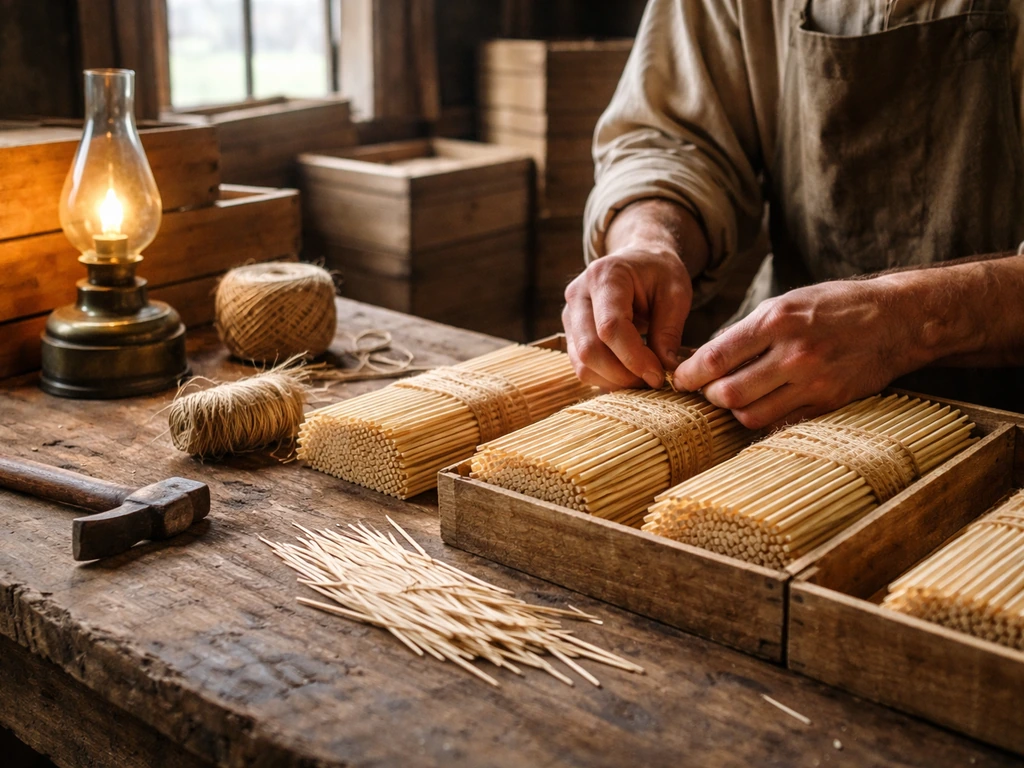
The financial turning point came when Forster acquired rights to a toothpick-making machine developed by Benjamin Franklin Sturtevant. With modifications made by a collaborator named Charles Freeman, the machine was producing commercially viable output by around 1869. This shift from hand production to automation was the core of his business model: high volume, low cost per unit, massive margin at scale. Owning the machinery rights and the production process gave him a structural competitive advantage that was very difficult to replicate.
Manufacturing footprint and raw material control
Forster was deliberate about locating his mills near streams and rivers, both for water power and proximity to the birch forests that supplied raw material. His first Dixfield, Maine operation launched in 1874. By 1887 he had moved his headquarters to Strong, Maine, setting up in an old starch mill on Valley Brook. A decade later, demand had grown so much that he purchased the J. W. Porter mill near the Strong railroad depot to expand capacity. Controlling your supply chain, your power source, and your distribution access was exactly the kind of vertical integration that built durable wealth in 19th-century American manufacturing.
Demand creation through restaurants

Forster's other genius was on the demand side. He reportedly paid young men to eat at restaurants, then loudly ask for a toothpick after their meal, creating social pressure on proprietors to stock them. This manufactured word-of-mouth drove restaurant adoption, which in turn created consumer expectations. Free toothpicks at the counter became standard, which meant restaurants needed steady bulk supply, which meant recurring commercial orders for Forster's mills. It was a flywheel: artificial demand created institutional purchasing, which funded production scale, which lowered unit cost, which made the product impossible to compete with. Historians have called him a "marketing genius" for exactly this reason.
Major financial milestones
- Late 1860s: Acquired rights to the Sturtevant toothpick machine and began automated production, establishing the manufacturing foundation of his wealth.
- 1874: Opened his first Maine mill operation in Dixfield, moving production out of Massachusetts and anchoring it in timber-rich New England.
- 1887: Established the Strong, Maine mill in a former starch mill on Valley Brook, which became his primary production headquarters.
- 1897: Purchased the J. W. Porter mill near the Strong railroad depot as demand outpaced existing capacity, doubling his local production footprint.
- Peak production era (late 1800s): Factory output reached approximately 500 million toothpicks per year, with products shipped nationally and internationally.
- Post-death: The "Estate of Charles Forster" was formally administered as a legal entity, still active enough to appear in 1930s National Recovery Administration regulatory filings.
- 1995: Diamond Brands acquired Forster Manufacturing Company, ending family/estate-era control of the business Forster founded.
- 2003: The Jarden Corporation acquired Diamond Brands and closed the last Strong, Maine mill, ending 130+ years of toothpick production there.
Earnings and wealth timeline
Forster's financial arc followed a classic 19th-century industrial trajectory. He started with limited capital, made a critical technology acquisition, built manufacturing infrastructure incrementally, and then compounded value through distribution reach and brand ubiquity.
- 1860s: Early-stage entrepreneur, likely operating with modest capital; wealth negligible at this point.
- Late 1860s to 1874: Machine rights acquisition and first operational mills mark the beginning of real asset accumulation.
- 1874 to 1887: Dixfield-era operations growing; Forster likely generating consistent profits but still building, not yet a wealthy industrialist by the standards of the era.
- 1887 to 1897: The Strong headquarters period, representing the height of his direct control and the years of greatest personal wealth accumulation.
- 1897 onward: Second mill acquisition in Strong signals he was reinvesting profits into expansion, a sign of a highly profitable underlying business.
- At death (estimated late 1890s to early 1900s): Peak personal wealth, likely representing a combination of mill real estate, machinery assets, receivables, and cash from decades of profitable operation.
- Post-death through 1930s: Estate administered as ongoing entity, suggesting continued revenue from the business he founded even after his death.
How net worth estimates like this are built (and why you should be skeptical)
For living public figures, net worth estimates typically combine known income streams (salaries, dividends, sale proceeds from documented transactions) with estimated asset values (real estate from public property records, equity stakes from SEC filings or business registrations) and subtract known or estimated liabilities. The challenge is that most wealthy people do not publish a balance sheet, so even modern estimates involve significant guesswork. For a historical figure like Charles Forster, the data gaps are even larger.
What we can verify: Maine state legislative records from 1898 document his mills. The Maine Memory Network has physical photographs of the Strong mill dated around 1900. The Congressional Record from 1979 specifically references his manufacturing in Strong. These are primary or near-primary sources that confirm the business existed and was substantial. What we cannot easily verify: the actual revenue and profit figures for Forster Manufacturing in the 1880s and 1890s, any personal investment or real estate holdings outside of Maine, and the final probate value of his estate.
If you want to go deeper, the right places to look are: Maine state archives for corporate or probate records; the Strong, Maine historical society or local library for mill-era business documents; Smithsonian and New England Historical Society collections for manufacturing-era financial data; and digitized 19th-century newspaper archives (especially Boston and Portland papers) which frequently covered industrial news including mill valuations and business transactions. GovInfo's digitized NRA documents are also worth searching for references to the Forster estate's financials in the 1930s context.
What could change or update this estimate
Unlike a living business figure, Charles Forster's net worth is not going to move with the stock market. If you are looking specifically for a Charles Forster net worth number, the key takeaway is that there is no widely published, audited figure because the underlying records were historical and incomplete. But the estimate could change meaningfully if new historical records surface. A probate court filing with an actual estate valuation would be the single most useful document.
A clearer picture of Charles Forster net worth is hard to pin down without a published probate valuation, but the available records help explain why estimates vary. Similarly, if digitization efforts at Maine or Massachusetts archives produce Forster Manufacturing ledgers or tax records from the 1880s and 1890s, that would allow a much more precise calculation.
Academic historians working on American industrial history occasionally publish new findings on figures like this, so it is worth monitoring journals focused on New England economic history or material culture.
On the company side, the 1995 Diamond Brands acquisition and 2003 Jarden closure are well-documented endpoints, but the acquisition price Forster's estate or heirs received in 1995 is not widely published. An AP-linked Sun Journal report on Forster Manufacturing says Forster Inc. was founded in 1887 by Charles Forster of Boston and that it later closed in 2003 after ownership changes and industry decline. If that figure appeared in business press archives or SEC filings from Diamond Brands or Jarden, it would provide a concrete modern data point for what the business was ultimately worth, which could anchor the historical estimates more firmly.
One practical note for readers doing their own research: be careful about confusing this Charles Forster with the fictional Charles Forstman from Suits, or with other Charles figures in adjacent industries. The Charles von Faber-Castell net worth topic is different, because that refers to a modern member of the Faber-Castell family of companies rather than 19th-century Forster. The toothpick connection is your clearest disambiguation signal. Any source that does not mention Strong, Maine, birch wood manufacturing, or the Forster Manufacturing Company is almost certainly talking about someone else.
FAQ
Why do online pages show wildly different numbers for Charles Forster toothpick net worth?
Most of those pages are mixing different people named Charles Forster or using modern “net worth” estimation methods without the primary missing inputs. For the 19th-century toothpick maker, the biggest driver of variation is that there is no widely published probate valuation and profit ledgers from the 1880s and 1890s are not broadly accessible.
Is Charles Forster the same person as Charles Forstman from Suits, or Charles Forte, or Charles Fabrikant?
No. The toothpick Charles Forster is a Boston-area industrialist tied to Forster Manufacturing Company and mills in Strong, Maine (including birch-based toothpick production). Charles Forstman is a fictional character, Charles Forte is a different hospitality magnate, and Charles Fabrikant is a modern executive.
What is the most reliable document that could confirm Charles Forster toothpick net worth more precisely?
A probate filing or estate inventory that includes an actual dollar value assigned to the estate assets. The article explains that such a valuation is not widely published in accessible databases, so any newly surfaced probate valuation would likely tighten the estimate more than any secondary source.
If there is no public balance sheet, how do historians or analysts estimate a 19th-century net worth range?
They typically triangulate from production scale (output and capacity), business endurance (how many mills and how long they operated), and the likely value of controllable inputs (machinery rights, water power access, raw material supply, and distribution). They may then apply inflation-adjusted valuation logic to approximate what similar businesses could have been worth at the time, but this remains an inference.
Does the “Estate of Charles Forster” mentioned in 1930s-era National Recovery Administration documents mean the estate was large?
It suggests ongoing administrative value significant enough to be referenced decades later, but it does not automatically equal a large personal net worth at the time of death. The entity could have been managing residual interests, ongoing business rights, or successor administration rather than representing a simple pile of liquid wealth.
How much does the Strong, Maine location and birch supply matter for the net worth estimate?
It matters because it supports the case for vertical integration. Access to water power and proximity to birch forests reduces key operating costs and lowers supply volatility, which would translate into stronger margins and business stability. That is one reason analysts treat manufacturing scale plus supply-chain control as indicators of wealth.
What would count as the biggest “missing piece” in the current estimation?
Either (1) historical profitability evidence like ledgers, tax records, or profit statements for Forster Manufacturing, or (2) a final probate valuation with an itemized estate inventory. Without one of those, estimates remain sensitive to assumptions about margins and asset ownership.
Could Charles Forster toothpick net worth increase if new historical records appear?
Yes. The article notes that any newly digitized corporate ledgers, tax records, or probate valuations could shift the estimate meaningfully, either upward or downward. In particular, discovering documentation that clarifies profits, debts, or personal asset holdings outside of Maine would change the range.
Do the Diamond Brands acquisition (1995) and Jarden closure (2003) help anchor his historical net worth?
They can provide context for later valuations of related successor businesses, but they usually do not directly translate into what Forster’s estate received in the late 1800s or 1930s administration. The missing anchor would be the acquisition price paid to Forster’s heirs or the estate, if such figures are recorded in business archives.
What common research mistake should I avoid when looking up Charles Forster toothpick net worth?
Searching for a generic “Charles Forster net worth” and then assuming every result is the same person. The article emphasizes disambiguation cues, such as references to Strong, Maine, birch toothpick manufacturing, or the Forster Manufacturing Company. If a source does not match those, treat it as likely unrelated.
Next Article
Charles Forstman Net Worth: What We Know and How to Check
Charles Forstman net worth explained with best estimate range, career context, and how to verify sources and red flags.