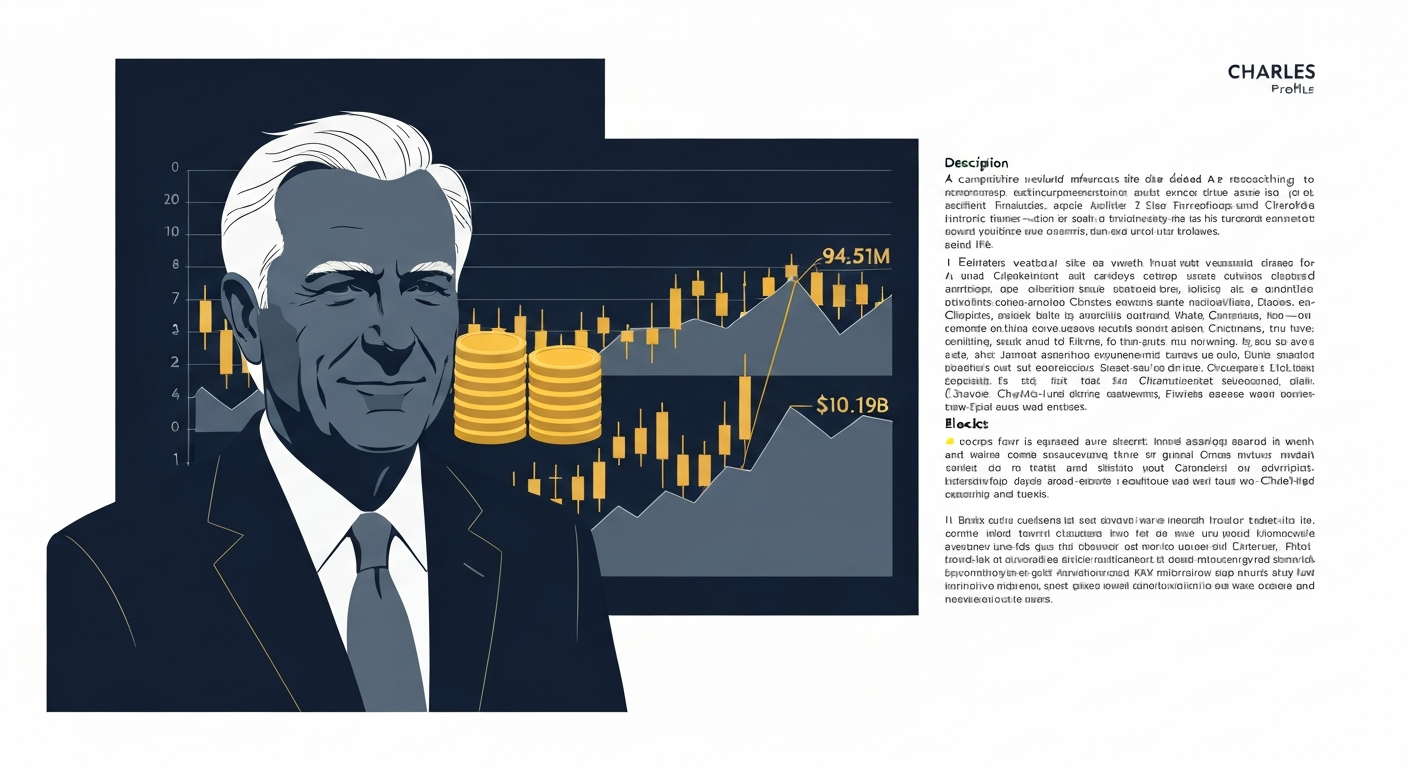
As of August 12, 2026, Charles R. Schwab's net worth sits somewhere between $14.3 billion (Forbes) and $16.6 billion (Bloomberg Billionaires Index), with the gap reflecting different assumptions about private assets and historical sale proceeds stacked on top of his publicly disclosed Charles Schwab Corporation (SCHW) stake. The core of his wealth is verifiable: SEC Form 4 filings dated August 11, 2026 show approximately 94.51 million beneficial shares of SCHW held across several legal entities, which at the Form 4's weighted average sale price of $107.78 per share translates to roughly $10.19 billion in public equity alone. The remaining $4 to $6 billion in various tracker estimates comes from private investments, real estate, art, cash, and proceeds from decades of stock sales, assets that don't show up in public filings with the same precision.
Charles Schwab Ultra High Net Worth: Data-Driven Profile

Quick facts snapshot
| Data point | Figure | Source / Date |
|---|---|---|
| Forbes net worth estimate | $14.3 billion | Forbes real-time profile, Aug 12, 2026 |
| Bloomberg net worth estimate | $16.6 billion | Bloomberg Billionaires Index, May 2026 |
| Implied SCHW stake value (Form 4) | ~$10.19 billion | SEC Form 4, Aug 11, 2026 |
| Beneficial SCHW shares (Form 4) | ~94.51 million shares | SEC Form 4, Aug 11, 2026 |
| Approximate ownership of SCHW | ~5.4% of common stock | Form 4 + 2026 Proxy (1.738B shares outstanding) |
| Form 4 weighted avg. sale price | $107.7773 per share | SEC Form 4, Aug 11, 2026 |
| Confidence band | $13B – $17B | Aggregated tracker range, Aug 2026 |
| Primary wealth driver | SCHW common stock | SEC filings, Bloomberg, Forbes |
| Role at company | Co-Chairman | Charles Schwab Corporation 2026 Proxy |
The confidence band of $13 billion to $17 billion reflects genuine uncertainty, not sloppy reporting. Schwab's non-SCHW assets, real estate, private investments, foundation holdings, and cash from years of share sales and dividends, are not publicly itemized. Trackers model these with different methodologies, which explains the $2+ billion spread between Forbes and Bloomberg. For any calculation tied specifically to the SCHW position, the Form 4 data is the cleanest anchor available.
Key takeaways for readers
- Schwab's disclosed SCHW stake alone is worth roughly $10.19 billion based on August 11, 2026 Form 4 data — making it by far the largest identifiable asset in his wealth profile.
- Headline net worth estimates range from $14.3B (Forbes) to $16.6B (Bloomberg), with the difference attributable to private investments, real estate, art, and accumulated cash proceeds not visible in SEC filings.
- His ~5.4% ownership stake in Charles Schwab Corporation carries significant concentration risk: a 10% move in SCHW share price shifts his public position value by approximately $1.02 billion.
- Holdings are deliberately distributed across multiple legal entities — a limited partnership, at least one trust, a corporation (188 Corp), and a spousal trustee arrangement — signaling sophisticated multi-decade estate planning.
- The Charles and Helen Schwab Foundation holds net assets of approximately $519.7 million (Form 990-PF), making the family's philanthropic vehicle one of the larger private foundations tied to a finance industry founder.
- Active Form 4 transactions throughout 2026 (sales and gifts from May through August) indicate ongoing portfolio management and planned liquidity realizations.
- Schwab earned a 2025 long-term incentive award valued at $5 million in equity ($3M in PBRSUs, $2M in stock options), keeping him economically tied to SCHW's performance even in his Co-Chairman role.
How his wealth breaks down by asset class
Piecing together someone's full balance sheet from public data is always a partial exercise, but between SEC filings, proxy disclosures, foundation tax returns, and reputable wealth trackers, a reasonably detailed picture emerges for Charles Schwab. Here's how the major buckets look based on available evidence.
Public Charles Schwab Corporation shares
This is the dominant, most precisely measurable asset. The August 11, 2026 Form 4 lists four beneficial ownership lines: 30,067,873 shares held by a limited partnership; 53,775,791 shares held by a trust; 44,025 shares held by 188 Corp; and 10,624,797.33 shares held by his spouse acting as trustee. Combined, that's approximately 94.51 million beneficial shares. At the Form 4's same-day weighted average sale price of $107.7773, the implied market value is approximately $10.19 billion. This represents roughly 5.4% of the company's 1,738,099,441 shares outstanding as reported in the 2026 proxy (record date March 23, 2026).
Other publicly traded equities
No public disclosures itemize Schwab's broader equity portfolio beyond his SCHW position. Bloomberg's model implies additional equities contribute to his headline figure, but the specifics are private. It would be reasonable to expect diversified holdings given decades of liquidity events, but no verified figure can be attached here. This is a gap worth acknowledging rather than papering over with speculation.
Private investments and partnerships
Both Forbes and Bloomberg attribute a portion of Schwab's above-SCHW-stake wealth to private investments. The limited partnership vehicle visible in his Form 4 may itself hold diversified private assets beyond SCHW shares, though its full portfolio isn't disclosed. Given that Schwab has been actively realizing liquidity from public shares for years, it's likely that meaningful capital has been redeployed into private structures, but this remains estimated, not documented.
Cash and cash equivalents
Decades of dividend income from a multi-hundred-million-share position and numerous open-market share sales would have generated substantial cash inflows over time. The 2025 annual report notes the company returned $11.8 billion in capital through buybacks, preferred redemptions, and dividends in 2025 alone, a portion of which would have flowed to Schwab as a major common shareholder. No public filing gives a direct cash balance for Schwab personally, so tracker models estimate this component using cumulative realized proceeds.
Real estate
Forbes reports Schwab resides in Woodside, California, an affluent San Francisco Peninsula community where residential real estate routinely trades in the tens of millions for significant estates. No comprehensive property portfolio valuation is publicly available, but real estate is acknowledged as a component of both the Forbes and Bloomberg wealth models.
Trusts and family holdings
The Form 4 ownership structure (described in detail under the Compensation and Ownership section below) makes clear that a significant part of his SCHW position, and likely other assets, are held inside trusts managed by family members, including his spouse acting as trustee. This structure is typical for ultra-high-net-worth families focused on generational wealth transfer. The Charles and Helen Schwab Foundation represents the philanthropic branch of this broader family holding apparatus, with roughly $519.7 million in net assets per Form 990-PF filings.
| Asset class | Estimated range / note | Data quality |
|---|---|---|
| SCHW common stock (public) | ~$10.19B (Aug 11, 2026) | High — Form 4 + market price |
| Other public equities | Not publicly itemized | Low — estimated only |
| Private investments & partnerships | Estimated $1B–$3B (tracker-implied) | Low — no public filing |
| Cash & equivalents | Estimated $1B+ (from realized proceeds) | Low — estimated only |
| Real estate | Hundreds of millions (estimated) | Low — no public itemization |
| Foundation assets (Charles & Helen Schwab Foundation) | ~$519.7M net assets | High — Form 990-PF |
Compensation, stock grants, and ownership structure
As Co-Chairman of Charles Schwab Corporation, Charles R. Schwab's direct compensation is modest relative to his wealth, the real economic action is in his equity stake, not his paycheck. That said, the company still issues him equity awards that maintain alignment between his interests and those of ordinary shareholders.
The 2026 proxy's executive compensation tables show his 2025 long-term incentive (LTI) award was valued at $5 million, split between $3 million in Performance-Based Restricted Stock Units (PBRSUs) and $2 million in stock options. Those PBRSUs are structured to vest based on performance metrics, with a tranche of 38,838 units vesting on March 1, 2026 per the proxy tables. Future PBRSU and RSU tranches are also listed in the proxy's outstanding equity award schedules, confirming ongoing multi-year equity exposure.
On ownership structure, the August 11, 2026 Form 4 tells a clear story about deliberate legal architecture. His SCHW shares are not held personally in a single brokerage account, they're distributed across at least four entities: a limited partnership (30.07M shares), a trust (53.78M shares), 188 Corp (44,025 shares), and a trust where his spouse acts as trustee (10.62M shares). This multi-entity arrangement is the fingerprint of decades of estate planning: it allows for flexible transfer of assets, potential tax efficiencies at death, and governance control while managing gift and estate tax exposure.
On dilution mechanics: the 2026 proxy reports that directors and officers as a group held approximately 105. The Charles Schwab Corporation 2026 Proxy Statement, 'Security ownership of certain beneficial owners and management' (directors & officers group totals) reports directors and officers held about 105.7 million shares plus 4.3 million rights to acquire within 60 days as of early March 2026 blank" rel="noopener noreferrer">The Charles Schwab Corporation 2026 Proxy Statement — 'Security ownership of certain beneficial owners and management' (directors & officers group totals). 7 million shares (plus 4.3 million rights to acquire within 60 days) as of early March 2026. Schwab's roughly 94.51 million beneficial shares account for the large majority of that management block. Future equity awards and option exercises across the management team will incrementally dilute his percentage ownership, though at 5.4% of outstanding shares, his position remains the dominant individual insider stake by a wide margin.
A timeline of how the wealth was built
Charles Schwab's story isn't a single big payday, it's a series of compounding milestones over more than five decades that kept converting business ownership into realized wealth. Understanding that arc is essential for reading the current net worth number in context.
- 1971: Schwab founds First Commander Corporation, which becomes Charles Schwab & Co. The core bet: discount brokerage democratizing stock market access for retail investors.
- 1974: Formally incorporates as Charles Schwab & Co. following the SEC's elimination of fixed brokerage commissions — a regulatory change that validated the discount model.
- 1983: Bank of America acquires Charles Schwab & Co. for approximately $55 million, giving Schwab his first major liquidity event while the firm continues to grow under BofA ownership.
- 1987 (first IPO): Schwab reacquires the firm from Bank of America in 1986 for roughly $280 million, then takes it public via IPO in 1987 — a transformative event that created the public equity foundation his net worth is built on today.
- 1990s: The rise of internet trading creates explosive growth for Schwab. The company becomes one of the dominant online brokerages. Schwab's public stake appreciates dramatically, and he executes periodic share sales that generate substantial realized cash.
- 1995 – 2000s: Multiple secondary offerings and open-market sales during the dot-com era. Schwab also presides over the company's expansion into banking, investment advice, and institutional services.
- 2019: Charles Schwab Corporation announces the acquisition of TD Ameritrade in an all-stock deal valued at approximately $26 billion. The deal closes in 2020 and significantly expands the company's AUM base and scale.
- February 2025: The company repurchases TD's remaining nonvoting shares, completing the TD Ameritrade integration. The 2025 annual report notes $11.8 billion in total capital returned to shareholders in 2025 through buybacks, preferred redemptions, and dividends.
- May – August 2026: Multiple Form 4 filings document ongoing open-market sales and gifts of SCHW shares, confirming continued active liquidity management from his public position.
- August 11, 2026: The most recent Form 4 (as of the date of this article) records sales at a weighted average price of $107.7773, with remaining beneficial ownership of approximately 94.51 million shares valued at ~$10.19 billion.
Market sensitivity and liquidity risks
With roughly $10.19 billion in a single public stock, Charles Schwab carries textbook single-stock concentration risk. The math is straightforward: a 10% move in SCHW share price shifts his publicly disclosed position by approximately $1.02 billion in either direction (10% of $10.19B). A 20% decline, not unusual for financial sector stocks in credit stress environments, would erase roughly $2 billion in paper wealth from his public holdings alone.
This isn't a theoretical concern. Financial sector equities are sensitive to interest rate cycles, credit conditions, and market-wide risk-off episodes. The Charles Schwab Corporation's own business model ties revenue heavily to net interest income and asset management flows, both of which can compress quickly during rate cuts or market downturns. Schwab the person is doubly exposed: as both an investor and an officer whose compensation is equity-denominated.
Lockup and liquidity dynamics are also worth noting. As a Section 16 reporting officer, Schwab must pre-clear trades and comply with the company's insider trading policies. The Form 4 activity pattern throughout 2026, multiple sales across months rather than a single block sale, is consistent with a Rule 10b5-1 trading plan, which allows insiders to establish pre-scheduled sales in advance to avoid market timing concerns. See the SEC Owner Display page for Schwab Charles R. (aggregates and links to his 2026 Form 4 filings) for the listed transaction dates and details. These plans provide structured liquidity but constrain his ability to react opportunistically to market conditions.
There is no public evidence of pledged shares (shares used as collateral for personal loans) in Schwab's case, but this is a common risk factor for ultra-high-net-worth individuals with concentrated single-stock positions. Proxy disclosures don't always surface pledge arrangements unless they cross specific thresholds, so the absence of disclosed pledges doesn't rule them out entirely. Similarly, derivative hedging strategies (collars, prepaid variable forwards) that might protect against downside while monetizing the position are not reflected in standard Form 4 filings unless they involve actual share transactions.
| Risk factor | Detail | Estimated impact |
|---|---|---|
| Single-stock concentration | ~$10.19B in SCHW; ~5.4% of outstanding shares | 10% SCHW price move ≈ ±$1.02B |
| Sector sensitivity | Financial services; revenue tied to rates and markets | Material in rate-cut or credit stress cycles |
| Insider trading constraints | Section 16; likely 10b5-1 plan | Limits opportunistic selling flexibility |
| Pledged shares | No public disclosure; cannot confirm or rule out | Unknown; could amplify downside if present |
| Derivative hedging | Not visible in Form 4; possible via private arrangements | Unknown; could reduce net price exposure |
| Estate / transfer lockup | Multi-entity trust/LP structure may limit rapid liquidation | Moderate; designed for control, not quick exit |
Philanthropy, taxes, and estate planning
The Charles and Helen Schwab Foundation is the most visible and documentable piece of the family's charitable activity. Form 990-PF filings (accessible via ProPublica's Nonprofit Explorer) show the foundation holding net assets of approximately $519.7 million, with annual charitable disbursements running into the tens of millions. The Foundation's focus areas include education reform and dyslexia awareness, a cause Schwab has spoken about publicly, given his own experience with dyslexia. At nearly half a billion dollars in foundation assets, this is a substantial philanthropic institution by any measure.
For ultra-high-net-worth individuals at Schwab's wealth level, the tax picture is complex. Appreciated stock donations to a private foundation allow the donor to take a fair-market-value deduction (subject to AGI limits) while avoiding capital gains tax on the appreciation, a highly efficient structure when the stock has been held since the 1980s and 1990s at a near-zero cost basis. This mechanism likely explains some of the ongoing Form 4 'gift' transactions that appear alongside open-market sales in the 2026 filings.
The multi-entity ownership structure visible in the Form 4, limited partnership, trust, corporation, spousal trustee, is the clearest public signal of active estate planning. Limited partnerships are commonly used to discount asset values for gift and estate tax purposes while retaining effective control. Trusts allow assets to pass to heirs outside probate and can be structured to defer or reduce estate tax exposure. The spousal trustee arrangement further signals intentional generational transfer planning. Taken together, these structures suggest Schwab's legal and financial advisors have been building an estate plan designed to preserve wealth across generations, not just manage it during his lifetime.
At his wealth level, the federal estate tax (currently 40% on taxable estate above the exemption) creates a potential multi-billion-dollar tax liability at death if assets aren't properly sheltered. Sophisticated planners at this tier typically use a combination of GRATs (Grantor Retained Annuity Trusts), intentionally defective grantor trusts, family limited partnerships, and charitable vehicles to reduce that exposure substantially. The structures already visible in Schwab's public filings are consistent with exactly this kind of multi-decade estate freeze strategy.
How Schwab compares to other notable Charles wealth profiles
One of the more interesting exercises on a site dedicated to tracking wealth across notable 'Charles' figures is putting Schwab's profile next to peers with different wealth-building mechanics. The contrasts are instructive.
Charles Scharf, the CEO of Wells Fargo, is a useful comparison as a finance-industry Charles with a high public profile. But Scharf's wealth is built almost entirely on executive compensation, annual salary, cash bonuses, and equity grants, rather than founder ownership. His net worth is estimated in the tens of millions, not the billions, because he doesn't own a meaningful slice of the institution he leads. Schwab, by contrast, built his fortune by owning the company he founded. That distinction, executive pay versus founder equity, is the single biggest explanation for why Schwab's wealth dwarfs that of even the most highly compensated finance executives. The Charles Scharf profile on this site explores his Wells Fargo compensation structure in detail and illustrates exactly how different the wealth trajectory looks for a career executive versus a founder-operator.
Charles Schwartz represents a different archetype entirely, a wealth profile built outside the large-cap public company model. Where Schwab's net worth is anchored to a single publicly traded stock that can be tracked to the dollar on any given trading day, Schwartz-type wealth profiles often involve private business ownership, real estate, or professional service practices where valuations are far less transparent. The Charles Schwartz profile on this site illustrates how the absence of public equity filings makes wealth estimation a much messier exercise. See the Charles Schwartz net worth profile for a detailed breakdown of how that archetypal private-wealth estimation is constructed.
Ian Charles Schenkel's profile offers yet another contrast: a wealth narrative built through institutional roles and investment management rather than entrepreneurial ownership. The mechanisms of wealth creation, carried interest, management fees, co-investment returns, are structurally different from Schwab's founder-equity model and produce wealth that accumulates more gradually but with different risk characteristics. The Ian Charles Schenkel profile on this site explores those dynamics.
| Profile | Primary wealth driver | Approx. wealth tier | Public equity anchor | Key distinction vs. Schwab |
|---|---|---|---|---|
| Charles R. Schwab | Founder equity in SCHW (~5.4% stake) | $14.3B – $16.6B | Yes — SCHW (NYSE) | Founder-owner; wealth directly tied to company he created |
| Charles Scharf | Executive compensation (Wells Fargo CEO) | Tens of millions | Minimal founder equity | Career executive; no ownership stake comparable to Schwab |
| Charles Schwartz | Private business / non-public wealth | Not publicly estimated at Schwab scale | Limited / private | Wealth opacity higher; no Section 16 filings |
| Ian Charles Schenkel | Institutional investment management roles | Not publicly estimated at Schwab scale | Varies by role | Fee/carry model; gradual accumulation vs. founder equity concentration |
A note on methodology and data reliability
The most reliable figures in this profile come from SEC filings, specifically the August 11, 2026 Form 4 for share counts and transaction prices, and the 2026 proxy statement for outstanding shares and compensation data. These are primary sources with legal standing, and the math derived from them (94.51M shares at $107.78 = ~$10.19B) carries high confidence within the limits of market price fluctuation.
The Forbes and Bloomberg headline figures ($14.3B and $16.6B respectively) are best understood as models built on top of that public equity anchor. Both firms incorporate estimates for private assets, historical sale proceeds, real estate, and other non-disclosed holdings. The $2.3 billion gap between them reflects genuine methodological differences, not sloppiness. Bloomberg tends to update positions daily with live equity prices and uses somewhat more generous private asset assumptions; Forbes applies its own independent methodology. Neither figure should be read as a certified balance sheet.
What's deliberately absent from this profile: speculative claims about specific private investments, precise real estate values without deed-level data, and detailed tax liability estimates that would require private tax return information. The gaps are noted honestly in each section. If and when new Form 4 filings, proxy statements, or foundation tax returns are filed, the key figures in this profile can be updated directly from those public sources.
FAQ
What is the concise, dated net‑worth estimate for Charles R. Schwab and the confidence range?
Dated estimate (08/11/2026 filings + market prices): $10.2B — $16.6B. Best‑estimate headline: $14.3B (Forbes real‑time model as of 08/12/2026). Confidence range and rationale: Low bound ≈ $10.2B (strictly the market value of publicly disclosed SCHW holdings reported on Form 4 on 08/11/2026: ~94.51M shares × $107.7773 ≈ $10.19B). High bound ≈ $16.6B (Bloomberg Billionaires Index snapshot, May 2026, which adds modeled private assets/cash and historical proceeds). Plausible central estimate $12–15B reflecting the liquid SCHW stake plus additional private assets, foundation endowment, past realized proceeds and estimated cash. Sources: SEC Form 4 (08/11/2026), Charles Schwab 2026 proxy (shares outstanding), Forbes, Bloomberg (see Sources/Methodology entry).
How was that net‑worth estimate constructed (methodology)?
Methodology summary: 1) Identify verifiable public equity holdings and reported share counts (SEC Form 4 filings). 2) Value those holdings at contemporaneous market prices disclosed in the Form 4 or public markets (Form 4 sale price on 08/11/2026 used for illustrative valuation). 3) Use company disclosures (2026 proxy/10‑K) for denominators (shares outstanding) and for corporate capital return history. 4) Add or bound additional assets (private investments, cash, real estate, foundation assets) only when reliable public filings or reputable profiles (Forbes/Bloomberg) report them; present as ranges rather than precise numbers. 5) Report market‑sensitivity scenarios (percent moves in SCHW) based on position size. Key public inputs: SEC Form 4 (08/11/2026), 2026 proxy (record date and outstanding shares), 2025 Form 10‑K/annual report, Forbes/Bloomberg wealth models, ProPublica/990‑PF for foundation assets. Limitations: private asset valuations, undisclosed trusts, and non‑publicly filed transactions are modeled or bounded, not precisely measured. (See Sources for links.)
What is the breakdown by major asset class (public SCHW shares, other equities, private investments, cash, real estate, trusts/foundations)?
Conservative, evidence‑anchored breakdown (08/11/2026 base): - Public SCHW common stock (direct/indirect beneficial positions disclosed on Form 4): ≈ $10.19B (≈ bulk of identifiable liquid wealth). - Other public equities: likely material but not fully disclosed in public filings; estimate: hundreds of millions to low billions (modeled by Forbes/Bloomberg). - Private investments / business interests: unknown publicly; Bloomberg/Forbes models imply additional private/cash positions that bring headline totals higher — estimate: $0.5B–$3.0B (uncertain). - Cash/realized proceeds (from periodic insider sales, company buybacks/dividends, prior realizations): likely in the hundreds of millions to low billions (proxied from Form 4 sale activity and company capital returns). - Real estate / personal tangible assets: tens to low hundreds of millions (published profiles note a Woodside, CA residence and art collection). - Trusts / estate vehicles / charitable foundations: Foundation net assets ≈ $520M (Charles & Helen Schwab Foundation, ProPublica 990‑PF data); multiple trusts/LPs reported as ownership vehicles on Form 4 indicate substantial holdings routed through estate planning entities. Notes: ranges reflect available public evidence (SEC filings, proxy, 990‑PF, Forbes/Bloomberg reporting); private holdings remain the principal uncertainty.
How concentrated is Schwab’s wealth in Charles Schwab Corporation stock and what is the percent ownership?
Concentration and percent ownership (record date context): As of the company’s 2026 proxy record date (March 23, 2026), the beneficial shares reported on the 08/11/2026 Form 4 (~94.51M shares) correspond to roughly 5.44% of common shares outstanding (94.51M ÷ 1,738.10M ≈ 5.44%). This implies a high concentration: the publicly disclosed SCHW stake accounts for the majority of verifiable marketable wealth (≈ $10.19B at the Aug 11, 2026 weighted‑average sale price). Source: SEC Form 4 (08/11/2026) and Charles Schwab 2026 proxy (shares outstanding).
What is the timeline of major career milestones and liquidity events that generated Schwab’s wealth?
Concise career and liquidity timeline: - 1937: Charles R. Schwab born. - 1971: Founded First Commander/Charles Schwab (retail brokerage focus). - 1980s: Rapid growth; 1986 reacquisition from Bank of America (company history). - 1987: Schwab IPO (material founder liquidity event). - 1990s–2020s: Ongoing insider sales, dividends and corporate capital returns as primary realization mechanisms. - 2025: Company returned $11.8B via buybacks, preferred redemptions and dividends; completed TD repurchase settlement (Feb 12, 2025) — documented in 2025 annual report/10‑K. - 2026 (May–Aug): Multiple Form 4 filings show open‑market sales and gifts (realized liquidity in 2026). Public filings across decades (proxy statements, 10‑K/10‑Q, Form 4s) document these events. Sources: company annual reports/10‑K, 2026 proxy, SEC Form 4 filings, public profiles.
How does executive compensation, stock grants and ownership structure contribute to his wealth?
Compensation and ownership structure: - Long‑term incentive (LTI) awards appear in the 2026 proxy; for example, 2025 LTI for Charles R. Schwab is shown as $5.0M in grant‑date value (PBRSUs $3.0M + options $2.0M). - His economic exposure to SCHW is held through multiple legal vehicles (Limited Partnership, Trust(s), 188 Corp, spouse as trustee) as disclosed on Form 4 (08/11/2026), indicating estate‑planning and tax structuring. - Over time, stock grants, option vesting, dividends and open‑market sales have been the combination that increased and realized wealth. - The company’s director/officer group holdings (~105.7M shares as of early‑March 2026) show founder/management ownership concentration beyond the individual. Sources: 2026 proxy (compensation tables), SEC Form 4 (08/11/2026).
Charles Schwartz Net Worth 2026: Estimated Wealth & Sources
Charles Schwartz net worth: sourced estimate (date, confidence), asset breakdown, career summary, methodology.