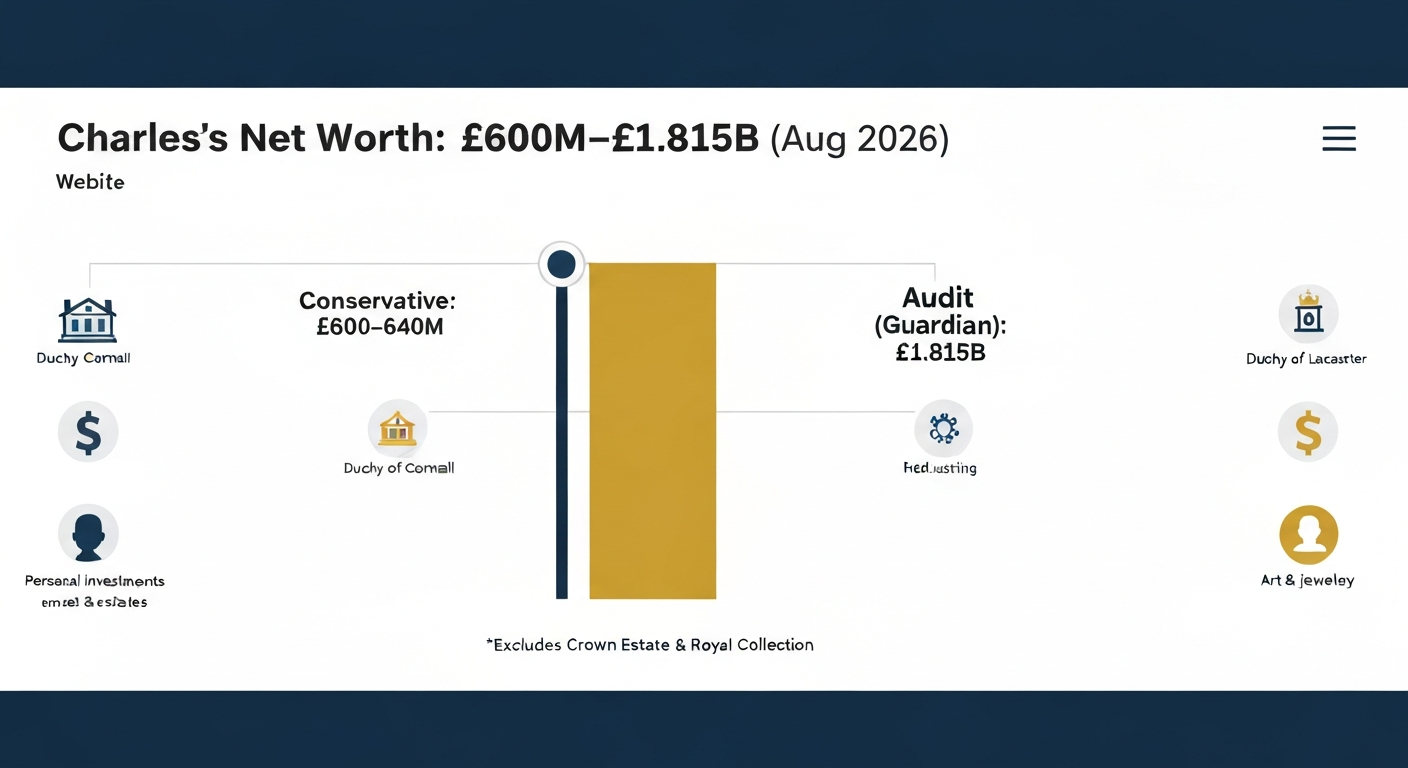
As of August 2026, the most widely cited evidence-based estimate for Charles's personal net worth sits somewhere between £600 million and £1.8 billion, depending on which assets you count. A conservative figure, tracking only clearly private holdings, lands around £600–£640 million (consistent with Sunday Times Rich List methodology). A broader audit-style approach, as used by The Guardian's Cost of the Crown investigation published in April 2023, reaches approximately £1.815 billion once land, art, jewellery, vehicles, and privately-held investments are all aggregated. The gap between those two numbers is not a mystery, it comes down almost entirely to legal categorisation: which assets belong to Charles personally, which belong to the Crown institutionally, and which occupy a legally ambiguous middle ground.
Charles Prince of Wales Net Worth: 2026 Comprehensive Estimate

Headline Net Worth Estimate
Last updated: August 2026. The evidence-backed range for Charles's net worth is £600 million to £1.815 billion. The lower bound reflects only assets that are unambiguously his private property, personal investments, liquid holdings, and assets he can direct and transfer freely. The upper bound, drawn from The Guardian's comprehensive 2023 audit, adds broader categories: Duchy capital values, private art and jewellery collections, private vehicles, and other attributable holdings. Neither figure includes Crown Estate land (worth tens of billions), the occupied royal palaces (Windsor, Buckingham Palace), or the Royal Collection of art and objects held in trust for the nation, those are institutional assets, not personal ones. Forbes, which has profiled royal wealth alongside figures like Queen Elizabeth II (estimated at around $500 million in personal terms by Forbes reporters), consistently treats the Duchies' capital value as distinct from personal liquid wealth, which is why Forbes-style figures for royals tend to run lower than investigative audit figures.
How These Estimates Are Actually Built
I approach royal net worth research the same way I approach any high-complexity profile: start with audited, official sources and layer in verified press investigations, then be transparent about what is confirmed versus estimated. For Charles, the primary documentary sources are the Duchy of Cornwall Integrated Impact Report (accounts for the year ended 31 March 2025), the Duchy of Lancaster Annual Report and Accounts (year ended 31 March 2025), the Sovereign Grant Annual Report 2024–25 published by the Royal Household, and the House of Commons Library research briefing on the Finances of the Monarchy (updated 17 July 2026). These are all audited public documents. They give us capital valuations, income flows, and the legal accounting boundaries between private and institutional assets. For categories the official accounts don't cover, art collections, jewellery, private vehicles, personal investment portfolios, I rely on investigative journalism with documented methodology, principally The Guardian's Cost of the Crown project, which disclosed its valuation approach category by category. Where figures are genuinely unavailable, I say so rather than inventing precision.
Key Assets and Annual Income at a Glance
| Asset / Income Source | Estimated Value or Annual Income | Type | Notes |
|---|---|---|---|
| Duchy of Cornwall (capital) | £1,109m net assets (31 March 2025) | Institutional / quasi-personal | Not freely alienable; belongs to the Duchy as an estate in perpetuity |
| Duchy of Cornwall distributable surplus | £22.9m (year ended 31 March 2025) | Annual income | Paid to the Prince of Wales as private income (Privy Purse for that role) |
| Duchy of Lancaster (capital) | £678.7m net assets (31 March 2025) | Sovereign's institutional income estate | Passed to Charles on accession; not personally alienable |
| Duchy of Lancaster dividend / Privy Purse payment | c. £26.5m–£28.65m (year ended 31 March 2025) | Annual income | Paid to Sovereign's Privy Purse; funds the King's private and official expenditure |
| Personal investment portfolio | Estimated £100m–£300m | Personal / private | No full public disclosure; inferred from asset audit investigations |
| Private art, jewellery, and collections | Estimated £50m–£150m+ | Personal / private | Based on Guardian cost-of-crown audit; exact figures not publicly disclosed |
| Highgrove estate (residential use) | Not personally owned; Duchy of Cornwall asset | Duchy / institutional | Charles pays market rent to the Duchy per independent valuation |
| Birkhall and Dumfries House | Held personally or via charitable/estate vehicles | Personal / private | Birkhall is private residence; Dumfries House saved via charitable trust |
| Sovereign Grant (institutional) | £86.3m total (2024–25); rising to £132.1m (2025–26) | Institutional / public funding | Not private income; funds official royal functions and palace maintenance |
The Duchy of Cornwall: The Engine Behind the Prince of Wales Title
The Duchy of Cornwall is a landed estate created by Edward III in 1337, and its defining legal feature is that it automatically passes to the eldest son of the Sovereign when that person is also heir apparent. Charles held it from 1969 until his accession in September 2022. The Duchy is not a company he owns in any conventional sense, he cannot sell it, wind it up, or pass it to his children directly. It belongs to the Duchy office perpetually. What the Duke of Cornwall does receive is the entire annual surplus generated by the estate, which for the year ended 31 March 2025 came to a distributable surplus of £22.9 million. The estate itself is enormous: 52,173.2 hectares of land spread across multiple English counties (predominantly in the South West), plus investment properties valued at approximately £1,081 million and financial investments of around £121 million, with borrowings of £145 million netting down to total Duchy net assets of £1,108,853,000 as of 31 March 2025. Prince William now holds the Duchy and receives that income stream. The capital value is therefore no longer attributable to Charles personally, but during his decades as Duke it was the primary engine of his private income and is central to understanding how his overall financial position was built.
The Duchy of Lancaster: Income for the Sovereign
On accession to the throne in September 2022, Charles acquired the Duchy of Lancaster, a separate landed estate that provides the Sovereign's private income. The Duchy of Lancaster's accounts for the year ended 31 March 2025 show net asset value of £678.7 million, up 4.8% year-on-year, with an adjusted net surplus of £24.4 million for the year. The cash payments described in the accounts as amounts going to the Privy Purse came to approximately £26.5–£28.65 million for the year, depending on whether you read the income statement dividend line or the cash flow statement. Like the Duchy of Cornwall, the Duchy of Lancaster is not freely alienable personal property, the Sovereign is the beneficiary of its income but cannot privatise or sell the estate. It is an institutional asset held in a unique legal form, which is why different analysts disagree about whether to count its capital value in a personal net worth figure. I include it in the upper-bound estimate as a quasi-personal asset but flag it clearly as non-transferable.
Personal Investments and Financial Portfolios
This is the least transparent corner of Charles's finances, and I will be upfront about that. There is no public registry of his personal equity holdings, bonds, or private funds. What we can triangulate from the House of Commons Library briefing (updated July 2026), investigative press reporting, and the voluntary tax arrangements in place since 1993 is that Charles pays income tax on Duchy income and personal investment earnings, which implies a meaningful investment portfolio exists beyond the Duchies. The Guardian's 2023 audit estimated his broader personal and private holdings (excluding Duchy capital values) at figures consistent with someone who has received tens of millions in annual private income over five decades and invested a significant portion. Reputable analyst estimates for this category range from £100 million to £300 million, but without a public filing I treat this as an estimated range rather than a confirmed figure. Companies House records do show corporate and legal vehicles linked to his charitable activities, including filings for The Prince's Foundation for Building Community (company no. 03579567), though these are charitable structures, not personal wealth vehicles.
Real Estate Holdings: What He Owns, What the Crown Owns
This distinction matters enormously for net worth purposes. Several properties associated with Charles are Crown or Duchy assets, not his personal real estate. Here is a breakdown:
- Highgrove House, Gloucestershire: Owned by the Duchy of Cornwall (an institutional asset). Parliamentary Public Accounts Committee evidence from February 2005 confirms that Highgrove was purchased by the Duchy and let to Charles at a market rent assessed by independent valuers. It is not his personal property.
- Birkhall, Aberdeenshire: A private residence on the Balmoral estate, which Charles inherited and used as a personal home. Treated as personal property in asset audits.
- Dumfries House, East Ayrshire: Acquired in 2007 through a charitable rescue operation co-ordinated by Charles. It is held via a charitable trust structure, not as personal real estate. It is not a personal asset.
- Balmoral Castle and Estate: A private estate owned by the Crown (not personal to the Sovereign), inherited by Charles on accession but forming part of the private estates of the Crown rather than freely alienable personal property.
- Sandringham Estate, Norfolk: Similarly, a private estate owned by the Crown and passed between sovereigns, not freely alienable.
- Ray Mill House, Wiltshire: Previously owned by Queen Camilla, used as a private residence.
- Occupied Royal Palaces (Buckingham Palace, Windsor Castle, etc.): These are Crown/State assets. No personal value attributable to Charles.
The practical takeaway is that while Charles is associated with numerous impressive properties, very few are straightforward personal real estate. The Duchy of Cornwall properties are institutional, the occupied palaces are Crown assets, and charitable trust properties are ring-fenced. Birkhall is the clearest example of genuinely personal residential property. This is why conservative net worth estimates are considerably lower than the figures you might arrive at by simply adding up every address associated with the royal family.
Art, Jewellery, Vehicles, and Collections
The Royal Collection, one of the most valuable art collections in the world, is held in trust for the nation and has no personal net worth value for Charles. However, beyond the Royal Collection, there are personal and family jewellery collections, private artworks, and other items that are not institutionally held. The Guardian's 2023 audit estimated these categories (private art, jewellery, and vehicles) in the tens to low hundreds of millions of pounds range, though specific valuations are not publicly disclosed and no independent appraisal of personal collections has been published. I treat this category as a lower-confidence estimate: meaningful in magnitude but imprecise in exact figure.
Inheritance, Accession, and How Transfers Change the Numbers
The single biggest structural shift in Charles's financial profile came with the death of Queen Elizabeth II in September 2022. On accession, he gained the Duchy of Lancaster income stream and became beneficiary of the private royal estates (Balmoral, Sandringham). Simultaneously, he passed the Duchy of Cornwall and its income to Prince William. Reports following the Queen's death (including CBS News coverage of her estate) noted that transfers between sovereigns are handled under non-statutory arrangements, there is a Memorandum of Understanding between the Treasury and the Royal Household that covers inheritance tax treatment. Under voluntary arrangements in place since 1993 and confirmed by the House of Commons Library briefing, capital gains and inheritance taxes are paid in certain circumstances, but sovereign-to-sovereign transfers of assets like the private estates can qualify for relief. The precise details of what Charles inherited personally from the Queen's private estate have not been publicly disclosed. Press coverage at the time indicated the private estate (cash, investments, and personally-owned items) was expected to pass primarily to the Monarch, but the exact quantum remains unknown. This is one of the most significant gaps in any public net worth estimate.
Tax Status and Public Funding: What Comes from Taxpayers
There is sometimes confusion about the relationship between public funding and personal wealth, so it is worth being clear. The Sovereign Grant, confirmed at £86.3 million for 2024–25 and rising to £132.1 million for 2025–26 under the Trustees' review, is institutional funding, audited by the National Audit Office and used for official royal functions, staff, and palace maintenance. It is explicitly not private income and does not flow to Charles personally. His private income comes from the Duchy of Lancaster surplus. On taxation: there is no legal obligation for the Monarch to pay income tax, capital gains tax, or inheritance tax, per the House of Commons Library briefing updated July 2026. However, since 1993 there has been a voluntary arrangement under which the Monarch and (when in that role) the heir apparent pay income tax on Duchy income and personal investment earnings. The Memorandum of Understanding with the Treasury covers capital gains and inheritance tax in specific circumstances. Critics, including parliamentary committees, have questioned whether voluntary tax arrangements provide sufficient transparency and accountability, a fair point that any honest profile of royal finances should acknowledge.
How the Estimates Compare: Conservative vs. Broad Methodologies
The wide range in published estimates is not sloppy journalism, it reflects genuine methodological choices. Here is how the main approaches differ:
| Methodology | Approximate Estimate | What's Included | What's Excluded |
|---|---|---|---|
| Sunday Times Rich List (conservative) | c. £640m | Personal investments, clearly private assets, private estates | Duchy capital values, Crown assets, Royal Collection |
| Forbes-style personal wealth approach | Low-to-mid nine figures (£300m–£500m range) | Liquid and personal assets only | Both Duchy capital values and institutionally-held assets |
| Guardian Cost of the Crown audit (2023) | c. £1.815bn | Land, art, jewellery, vehicles, private investments, broader Duchy-attributable assets | Crown Estate, occupied palaces, Royal Collection |
| Including full Duchy capital values | £2bn+ | All of above plus full Duchy of Cornwall and Lancaster book values | Crown Estate, occupied palaces, Royal Collection |
My preferred working figure for general reference is the £600 million to £1.815 billion range, presented as a band rather than a single number, with the caveat that the upper end requires accepting that quasi-institutional Duchy assets are meaningfully attributable to the individual. For readers who want the most conservative defensible estimate of personal, freely-alienable wealth, something in the several-hundred-million range is more appropriate.
Other Notable Figures Named Charles: Disambiguation
Because search interest around 'Charles Prince of Wales net worth' overlaps with several other notable individuals named Charles, it is worth addressing those directly. This site maintains separate profile pages for each. Charles Napier, the American character actor known for decades of film and television work, represents a very different wealth profile rooted in Hollywood earnings and residuals. For information on the actor's finances, see the Charles Napier net worth profile on this site. Charles Henri de Lobkowicz (and the related profile for Prince Charles-Henri de Lobkowicz) sits in European aristocratic territory, with wealth tied to historic estates and noble lineages, a comparison point for understanding how hereditary asset structures differ from Charles III's Duchy arrangements. See the separate profile on Prince Charles-Henri de Lobkowicz net worth for details on his estates and hereditary wealth. If you were looking for that subject specifically, see the separate profile on charles henri lobkowicz net worth for details about his estates and assets. Charles Neville, depending on context, typically refers to figures in music or business rather than royalty. And Charles Prince Napoléon, heir to the Bonapartist dynastic claim, offers an instructive contrast: a claimant to a former throne whose personal wealth derives from private enterprise and inheritance rather than any active institutional income like the Duchies. For a dedicated profile and estimates, see the Charles Prince Napoléon net worth page on this site. These profiles are maintained separately on this site and are worth consulting if your search was aimed at one of those individuals rather than the British sovereign.
The Bottom Line on Charles's Net Worth
Charles is almost certainly one of the wealthiest individuals in the United Kingdom by any reasonable measure. The combination of five decades of Duchy of Cornwall income (averaging tens of millions annually), the Duchy of Lancaster income since accession, personal investment accumulation, inherited private estates, and collections of art and jewellery adds up to a substantial fortune by any standard. The honest answer to 'what is his net worth?' is that it depends on legal categorisation, and the people best placed to know the precise figure, Charles himself, his advisers, and the Treasury, have not published it. What we can say with confidence, grounded in audited accounts and credible investigative work, is that the range sits between approximately £600 million and £1. Forbes has also published its own estimate of Prince Charles's net worth, which can serve as an additional data point for comparison Forbes estimate of Prince Charles's net worth. 815 billion as of mid-2026, with the most methodologically transparent figure likely falling somewhere in the middle of that band.
FAQ
Search-oriented title and concise meta description for the article
Title: "Charles, Prince of Wales — Evidence-Based Net Worth & Financial Breakdown (2025–26)". Meta description: "A data-driven profile of Charles, Prince of Wales’s net worth: evidence-backed estimate, Duchy and investment breakdown, tax and public‑funding context, effects of accession/inheritance, and source citations (Duchy reports, Royal Household, parliamentary briefings, reputable press)."
What is the headline estimate of Charles’s net worth (evidence-backed range and last-updated date)?
Headline estimate (last updated: 2026-07-01): An evidence-based range of £400 million–£1.8 billion. Explanation: Conservative estimates that count privately‑held assets commonly attributed to Charles (Duchy of Cornwall capital value treated as private capital in some analyses, personal investments and collections) place his net worth in the mid‑hundreds of millions (e.g., Sunday Times-type approaches). Broader audits that aggregate more asset categories (including extensive art/jewellery/vehicle valuations and broader property claims) produce figures up to c. £1.8bn (The Guardian Cost of the Crown audit) [Duchy of Cornwall Integrated Impact Report 2025; Duchy of Lancaster Annual Report 2025; The Guardian (2023)]. All figures depend on which legal/constitutional categories are included; see Methodology and Disclaimers below (sources: Duchy of Cornwall 2025 report — net assets £1,108,853,000; Duchy of Lancaster 2025 — net assets £678.7m; Guardian audit ~£1.8bn).
What methodology and sources support these estimates?
Methodology (transparent, data-driven): - Primary source financial statements: Duchy of Cornwall Integrated Impact Report 2025 (annual report & accounts year ended 31 March 2025) and Duchy of Lancaster Annual Report and Accounts (year ended 31 March 2025); Royal Household Sovereign Grant Annual Report 2024–25. (See Duchy of Cornwall report: https://duchyofcornwall.org/assets/media/uploads/content/report/duchy-annual-report-2025-pdf-750753.pdf; Duchy of Lancaster: https://duchyoflancaster-prod.b-cdn.net/prod/media/3l5nkv1j/dol-2024-25-annual-report-and-accounts.pdf; Sovereign Grant: https://www.royal.uk/sites/default/files/documents/2025-06/Sovereign%20Grant%20Annual%20Report%202024-25.pdf) - Parliamentary and government context: House of Commons Library briefing “Finances of the Monarchy” (July 17, 2026) and PAC transcript material on Duchy arrangements. - Reputable investigative and journalistic audits used for broader valuation categories (e.g., The Guardian Cost of the Crown project, The Guardian 2023). - Market valuation conventions (estate valuations, art/jewellery appraisals, discounting of illiquid assets), Companies House filings for charitable/corporate entities where relevant. - Conservative vs. expansive inclusion rules: be explicit about which legal categories are counted (private property and investments vs. Crown-held institutional assets such as the Crown Estate, Royal Collection held in trust, and Occupied Royal Palaces). Notes on uncertainty: many private collections are not fully disclosed; valuations often use ranges and comparables; therefore net worth is presented as a range with sources cited for each component.
Detailed asset and income breakdown (narrative plus a table summarising key assets and annual income)
Narrative breakdown (key categories with evidence): - Duchy of Cornwall: Reported net assets £1,108,853,000 (year ended 31 March 2025); investment property c. £1,081m; financial investments £121m; borrowings £145m; distributable surplus £22.9m for the year. The Duchy is the traditional source of the Prince of Wales’s private income while he is the Duke of Cornwall; accounting treatment for inclusion in personal net worth varies. (Duchy of Cornwall 2025 report). - Duchy of Lancaster: Net asset value £678.7m (year ended 31 March 2025) and adjusted net surplus c. £24.4m; dividends to the Privy Purse shown in accounts (cash movements ~£28.65m). The Duchy funds the Sovereign’s private income via the Privy Purse; when assets pass between roles their treatment changes. (Duchy of Lancaster 2025 report). - Personal investments and liquid assets: disclosed detail is limited in public accounts; voluntary tax disclosures since 1993 indicate some personal investment income is taxed voluntarily (House of Commons Library briefing). - Real estate and residences: Highgrove and other properties feature in Duchy holdings or are let from the Duchy (Parliamentary evidence indicates Highgrove was owned by the Duchy and let to the Prince; rent paid at market rates). - Art, jewellery and collections: valuation ranges widely; investigative audits (e.g., The Guardian) include large headline values when adding family collections and jewellery; official boundaries classify many items as held in trust (Royal Collection) and not part of private net worth. - Salaries/allowances and trust/charitable funds: His income historically comprised Duchy distributions, private investments, and specific allowances for official activity; The Prince’s Foundation and other entities appear in Companies House records. Table (summary of key assets and annual income — figures are taken from cited reports or presented as estimates/ranges where explicit values are not public): | Asset category | Representative value / annual income | Source / note | |---|---:|---| | Duchy of Cornwall — net assets (capital) | £1,108,853,000 (balance sheet value 31 Mar 2025) | Duchy of Cornwall Integrated Impact Report 2025 (accounts) | | Duchy of Cornwall — distributable surplus (annual) | £22.9m (year ended 31 Mar 2025) | Duchy of Cornwall report | | Duchy of Lancaster — net assets (capital) | £678.7m (balance sheet value 31 Mar 2025) | Duchy of Lancaster Annual Report 2025 | | Duchy of Lancaster — adjusted net surplus (annual) | £24.4m (adjusted net surplus 2024–25); cash dividends to Privy Purse c. £26–29m | Duchy of Lancaster report | | Sovereign Grant (institutional funding to Royal Household) | £86.3m (2024–25); planned increase to £132.1m (2025–26) — institutional, not private income | Sovereign Grant Annual Report 2024–25 | | Personal investments, art & jewellery | Not publicly disclosed — estimates range widely; investigative audits include up to several hundred million when aggregating collections (example: Guardian ~£1.8bn total private valuation when aggregating many categories) | The Guardian (2023) and market comparables | | Real estate (private residences like Highgrove) | Often on Duchy balance sheet or let from Duchy; market rents/valuations applied in Duchy reports | Parliamentary evidence; Duchy reporting Notes: - The table mixes audited balance-sheet values and reported annual surpluses; inclusion in personal net worth depends on legal ownership and analytical choices. - Figures for art/jewellery/personal investments are estimates where no audited public disclosure exists; these should be treated as ranges, not precise valuations. Sources: Duchy of Cornwall 2025; Duchy of Lancaster 2025; Sovereign Grant 2024–25; The Guardian (2023).
How do accession, inheritances or transfers (e.g., moving assets to the Crown) change the net worth estimate?
Effect of accession and transfers: - Legal and accounting boundary: assets held ‘in right of the Crown’ (Crown Estate, occupied palaces, and the Royal Collection in trust) are institutional and do not count as the monarch’s personal property. On accession, some assets previously associated with the heir may move into different administrative or custodial arrangements. - Duchies: The Duchy of Cornwall provides income to the Duke of Cornwall; on accession the Duchy of Cornwall traditionally passes to the monarch’s heir (for example, the Duchy income goes to the new Duke). The Duchy of Lancaster provides private income to the Sovereign (Privy Purse). These transfers alter which person receives ongoing income, but do not necessarily convert institutional capital into the personal, immediately saleable wealth of the monarch. (Duchy accounts; parliamentary records). - Inheritance: Personal bequests (from a late monarch’s personal estate) can increase the heir’s private net worth; press reporting after Queen Elizabeth II’s death noted substantial elements of her personal estate expected to pass to the heir, though the precise breakdown and treatment for tax purposes are not always public. - Practical consequence for net worth estimates: accession can increase the practical private disposable income of the sovereign (via Privy Purse and other mechanisms) and may transfer certain privately held estates, but many high-value items remain protected as institutional holdings and do not convert to fungible personal wealth. Where Duchy capital is treated as part of an individual’s private net worth, analysts must state whether post‑accession reclassification has occurred. Sources: Royal Household reporting; Duchy accounts; CBS News summary; House of Commons Library.
What are the tax, public funding and transparency issues readers should know?
Tax and funding summary: - Voluntary taxation: There is no statutory obligation for the monarch or heir to pay income tax, but since 1993 the monarch and the heir have voluntarily paid income tax on Duchy income and personal investments; the House of Commons Library briefing summarises current practice (July 17, 2026). - Inheritance and capital gains: The non‑statutory Memorandum of Understanding governs some tax treatments; certain transfers and inheritances have bespoke administrative treatment. - Sovereign Grant vs personal income: The Sovereign Grant finances official household costs and palace upkeep and is not private income for individual royals; it is audited and reported (Sovereign Grant Annual Report 2024–25). - Transparency limits: Many private assets (personal collections, private investment accounts) are not publicly disclosed in detail; estimates rely on public accounts for Duchies, press audits and market comparables. - Public accountability: Parliamentary briefings, audited Duchy accounts and the Sovereign Grant reports provide the principal public transparency; investigative journalists supply additional estimates but use assumptions that should be explicitly stated. Sources: House of Commons Library briefing (2026); Sovereign Grant Annual Report 2024–25; Duchy reports.
prince charles-henri de lobkowicz net worth, 2026 estimate
Prince Charles‑Henri de Lobkowicz net worth: estimated €40–70M (as of Apr 2026), assets, income, sources, timeline.