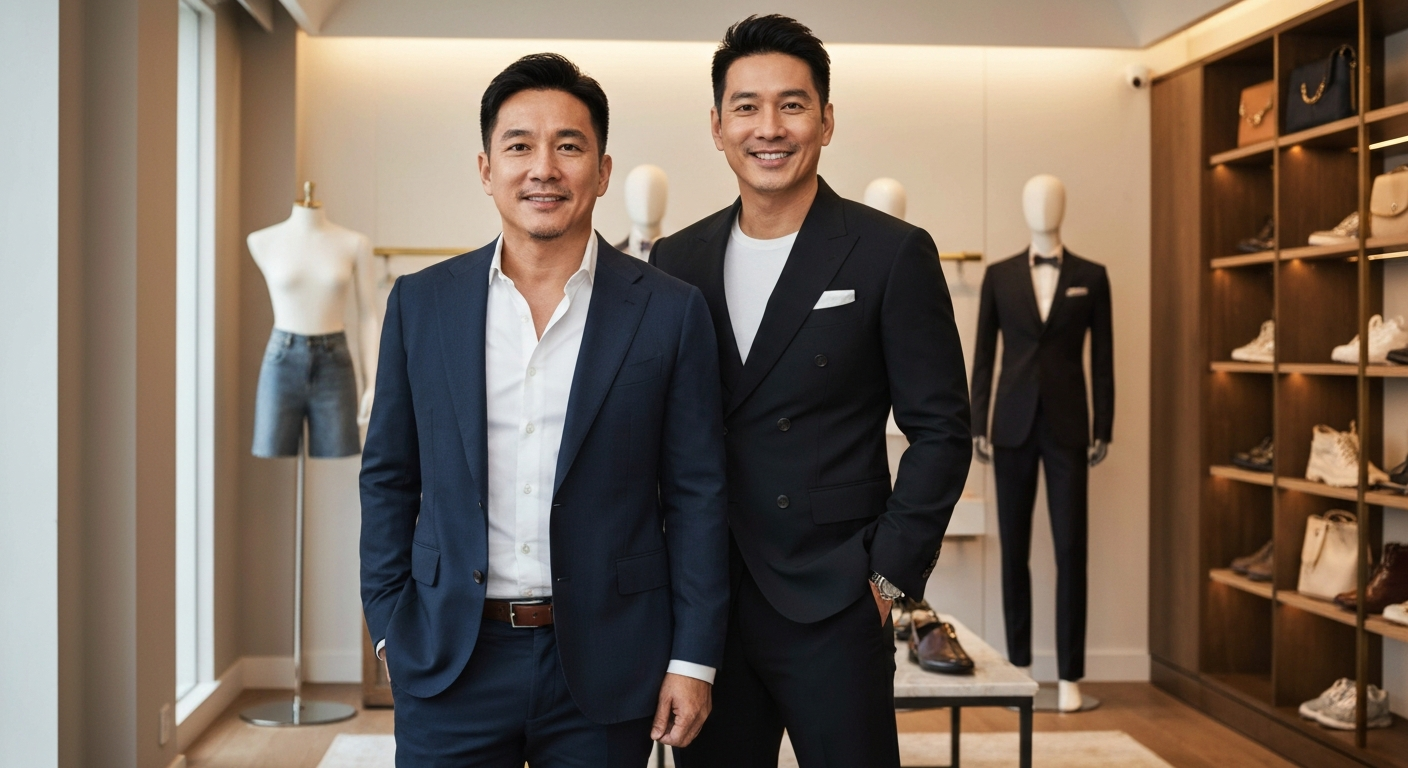
Charles and Keith Wong, the Singaporean brothers behind the Charles & Keith fashion group, have a combined estimated net worth of approximately US$1.3 billion as of 2024, according to Forbes and Business Times reporting. Individually, estimates typically place each brother in the US$600–700 million range, though the split is not publicly disclosed and the figures carry meaningful uncertainty given the company remains privately held. See the Charles Wong net worth profile for a focused estimate of Charles Wong's personal fortune. See our detailed article on charles and keith net worth for further context and sourcing.
Charles and Keith Wong Net Worth: Estimated Wealth 2026

Marcus Rothwell
12 Jul 2026
Quick net worth summary
The most credible public reference for the Wongs' wealth comes from Forbes Asia's Singapore 50 Richest list, which has historically placed the brothers in the low-to-mid USD billion band. A Business Times profile from May 2024 cited a combined Forbes estimate of approximately US$1.3 billion. An earlier Forbes snapshot placed them at US$1.04 billion combined. Because the company is private, no audited ownership-linked balance sheet is publicly available, so every figure is a third-party estimate derived from revenue multiples, comparable transactions, and reported ownership stakes.
| Subject | Estimated Net Worth | Confidence Level | Primary Basis |
|---|---|---|---|
| Charles Wong (co-founder, co-CEO) | ~US$600–700M | Moderate | Forbes list, revenue multiples, inferred 50% stake |
| Keith Wong (co-founder, co-CEO) | ~US$600–700M | Moderate | Forbes list, revenue multiples, inferred 50% stake |
| Combined (Charles & Keith Wong) | ~US$1.0–1.3B | Moderate-High | Forbes Asia Singapore 50 Richest (2023–2024 editions) |
Confidence is rated moderate for individual figures because the ownership split between the brothers is not publicly documented. The combined estimate carries slightly higher confidence because it rests on published Forbes methodology and corroborating Business Times reporting. Any material change in the company's valuation multiple, debt structure, or a future IPO or trade sale would shift these numbers significantly.
Who are Charles and Keith Wong?
Charles and Keith Wong are Singaporean brothers and co-founders of the Charles & Keith Group, a fast-fashion footwear and accessories company headquartered at 6 Tai Seng Link, Singapore. They are not to be confused with other notable figures named Charles Wong, for instance, the Charles Wong profiled separately on this site as a Hong Kong business figure, or the broader category of Charles Wong profiles that appear in Singapore's corporate registry. The brothers are the specific Charles and Keith Wong who appear on Forbes' Singapore rich lists and in Business Times coverage of the local fashion industry.
Charles Wong serves as co-founder and co-CEO of the Charles & Keith Group. Keith Wong shares the co-CEO role. Both brothers grew up in Singapore and entered the retail fashion business in their early twenties. Charles, the older of the two, is generally cited first in corporate materials and press profiles and is the more publicly visible of the pair. Keith focuses on the operational and creative side of the business, while Charles has historically fronted the brand's strategic expansion decisions. The Business Times profile from May 2024 described Charles as driven by an all-or-nothing approach to business building, quoting him directly on the philosophy behind the brand's aggressive international expansion.
The Charles & Keith brand: from a Singaporean shophouse to 700 stores
Charles & Keith was founded in 1996, when the brothers opened their first store in Amara Shopping Centre in Singapore. The original concept was a value-priced women's footwear label competing on fast-fashion economics: trend-responsive designs at accessible price points. That formula proved durable. Over the following three decades the brand expanded across Southeast Asia, the Middle East, Europe, and beyond. The corporate group also houses PEDRO, a men's and women's footwear and accessories label that the group developed as a complementary brand targeting a slightly more premium positioning.
As of the most recent public data points, the Charles & Keith Group operates approximately 600 to 700 stores across multiple countries and employs roughly 4,000 people globally, according to the group's LinkedIn company profile. The group's headquarters is registered at 6 Tai Seng Link, Singapore 534101. Key corporate entities include CHARLES & KEITH INTERNATIONAL PTE. LTD. (UEN 200500088E, incorporated 3 January 2005) and CHARLES & KEITH (SINGAPORE) PTE. LTD. (UEN 200802300D, incorporated 31 January 2008), both traceable through Singapore's ACRA BizFile+ registry. Companies.sg lists CHARLES & KEITH (SINGAPORE) PTE. LTD. (UEN 200802300D), incorporated 31 Jan 2008, showing paid‑up capital and a registered address at 6 Tai Seng Link, Singapore Companies.sg lists CHARLES & KEITH (SINGAPORE) PTE. LTD. (UEN 200802300D), incorporated 31 Jan 2008, showing paid‑up capital and a registered address at 6 Tai Seng Link, Singapore..
How the Wongs built their wealth
The core wealth driver is straightforward: the brothers own the equity in a profitable, high-revenue consumer fashion business that they built from scratch without surrendering majority control. That is the key structural fact. Unlike many founder stories where early venture rounds dilute ownership to minority levels, the Wongs entered and exited a minority investment arrangement with L Capital Asia in 2011 and ultimately reacquired full ownership, meaning their equity stake in the business today is understood to be very close to, or at, 100%.
The wealth-building story moves through three broad phases. The first is organic domestic growth from 1996 to the late 2000s, where the brothers reinvested profits to expand within Singapore and Southeast Asia. The second phase is accelerated international expansion, roughly 2008 to 2018, during which the brand entered the Middle East, Europe, and major Asian markets aggressively. The third phase is consolidation and scale, from around 2018 onward, where the group pushed toward the US$1 billion revenue threshold and began positioning the brand in higher-tier retail environments globally.
Revenue, profitability and financial benchmarks
The most concrete public revenue figure comes from an ACRA filing referenced by Business Times in May 2024: the group posted close to US$1 billion in revenue for the financial year ended March 2023. That is a significant milestone for an Asian-origin fashion brand without a stock exchange listing. For context, fast-fashion and accessible-luxury footwear groups of comparable scale typically trade at enterprise value multiples of 1.5 to 3 times annual revenue in public markets, depending on margin profile and growth rate. Applying even a conservative 1.5x multiple to US$1 billion in revenue implies an enterprise value in the US$1.5 billion range, which is broadly consistent with the combined net worth estimates published by Forbes.
Profitability data for the group is not publicly disclosed in detail. Singapore private companies are required to file annual returns with ACRA, but full financial statements with income and margin breakdowns are not always made publicly available in the same way as listed-company filings. What is known is that the business has sustained multi-decade growth without reported financial distress and completed a meaningful private equity investment cycle, both of which imply a structurally profitable operating model. Retail gross margins for footwear brands at Charles & Keith's positioning typically run in the 50 to 60% range, with operating margins varying widely based on store expansion costs and geography.
Ownership stakes, the L Capital investment, and how the Wongs got it back
The single most consequential external transaction in the company's financial history is the 2011 minority investment by L Capital Asia, the private equity arm associated with LVMH (later rebranded under the L Catterton umbrella). L Capital Asia acquired approximately 20% of Charles & Keith for a reported sum in excess of S$30 million. Forbes Asia Looks Back At Two Decades, Forbes (Asia) also documents the brand's history and provides contemporary context for the 2011 L Capital Asia minority investment Forbes Asia Looks Back At Two Decades — Forbes (Asia). At the time, that deal implied an enterprise valuation in the vicinity of S$200 million (roughly US$160 million at 2011 exchange rates), which was a meaningful benchmark for the brand's value at a relatively early stage of its international expansion.
Subsequently, according to multiple secondary sources including a detailed brand analysis by Martin Roll, the Wong family reacquired the outside stake and the company returned to full family ownership. The precise terms of the buyback, including the price paid and the year completed, are not publicly documented in detail. If the company's value had grown substantially between the 2011 investment and the buyback (which the revenue trajectory suggests it did), the Wongs effectively bought out L Capital Asia at a valuation higher than the entry price, meaning the buyback was expensive but the founders preserved full upside on subsequent growth. L Catterton's Asia office, as successor to L Capital Asia, would hold historical fund records for anyone pursuing primary document verification.
No subsequent external equity transactions have been publicly reported as of mid-2026. There is no confirmed IPO filing or announced trade sale process. The company is understood to remain wholly family-owned, which means the brothers' combined equity represents their primary wealth asset and its value is entirely tied to the private market valuation of the group.
Brand valuation, retail footprint, and other income streams
Beyond the operating business, the Charles & Keith brand itself carries standalone intangible value. Brand valuation methodologies (royalty relief, income approach) for a business of this scale and recognition would likely produce figures in the hundreds of millions of dollars, though no formal independent brand valuation has been publicly published. The retail footprint of 600 to 700 stores across roughly 40 countries (per various corporate summaries and industry profiles) provides geographic diversification that reduces single-market risk and supports a premium on the enterprise valuation multiple.
The group operates both directly owned stores and franchise or partner arrangements in certain markets, particularly in the Middle East and parts of Asia where local regulatory or commercial structures favor partnership models. Franchise and licensing fees from these arrangements represent an income stream that does not require capital investment from the group, though the total contribution of this stream relative to directly operated store revenue is not publicly disclosed. The PEDRO brand adds a second revenue and brand equity layer to the group's total valuation.
Property holdings connected to the founders personally are not documented in public sources available for this article. Singapore property ownership records are held by the Singapore Land Authority (SLA) and are searchable through its INLIS e-services portal, which would be the authoritative route for anyone wanting to verify titled property assets held by the founders in Singapore.
Financial timeline: key milestones
| Year | Milestone | Financial Significance |
|---|---|---|
| 1996 | First Charles & Keith store opens in Amara Shopping Centre, Singapore | Brand founding; initial capital deployment |
| 2005 | Charles & Keith International Pte. Ltd. incorporated (UEN 200500088E) | Corporate structure formalized for international expansion |
| 2008 | Charles & Keith (Singapore) Pte. Ltd. incorporated (UEN 200802300D) | Domestic operating entity restructured; Middle East expansion accelerates |
| 2011 | L Capital Asia (LVMH-linked PE) acquires ~20% stake for >S$30M | Implied enterprise value ~S$200M; first major external valuation anchor |
| 2011–2018 | International store rollout: Middle East, Europe, Asia | Revenue scale drives valuation growth; store count approaches hundreds |
| Post-2018 | Wong family reacquires L Capital Asia stake; 100% family ownership restored | Full upside on subsequent growth retained by founders |
| FY ended March 2023 | Group revenue approaches US$1 billion (per ACRA filing cited by BT) | Revenue threshold hit; implied valuation US$1.5B+ at conservative multiples |
| 2024 | Forbes Singapore 50 Richest: combined net worth ~US$1.3B | Most recent credible published wealth estimate |
How to verify these figures yourself
The most direct path to primary data is Singapore's ACRA BizFile+ portal. A Business Profile for any registered Singapore company costs approximately S$5.50 and can be purchased and downloaded online. For the Charles & Keith entities, searching UEN 200500088E (Charles & Keith International) or UEN 200802300D (Charles & Keith Singapore) will return the registered Business Profile including shareholder register summaries, paid-up capital, and registered address. Full financial statements, where filed, require additional paid extracts. Annual return filings are also searchable through BizFile+. Corporate secretarial firms offer guides on the exact BizFile+ purchase process if you are unfamiliar with the portal.
For property assets, the Singapore Land Authority's e-services portal (INLIS or its successor system) is the official route for title searches on Singapore land parcels. For the PE transaction history, L Catterton's Asia office (as successor to L Capital Asia) would hold historical fund documentation, though such records are typically not publicly shared. Forbes Asia's published methodology notes for its Singapore 50 Richest list explain how the publication derives its estimates, which is useful context for understanding the confidence interval around the combined US$1.3 billion figure.
What the wealth estimate does and doesn't tell you
Net worth estimates for private company founders are inherently imprecise. The US$1.3 billion combined figure is best understood as a midpoint in a plausible range rather than a verified balance sheet total. The lower bound of that range is probably around US$800 million (applying a 1x revenue multiple and assuming some debt), while the upper bound at a growth-company multiple could reach US$2 billion or more if the brand's international positioning continues to strengthen. The figure will also move materially if the company pursues an IPO, completes a strategic sale, or takes on significant external debt.
For readers exploring wealth accumulation patterns across the Charles profiles on this site, the Wong brothers' story is a useful contrast to, say, the financial trajectories visible in profiles like Charles Heung (whose wealth is rooted in Hong Kong entertainment and property) or Charles Keating (whose story is defined by financial collapse rather than sustained growth). For a contrasting example of a Charles whose finances are discussed elsewhere on this site, see the profile on Charles Keating, including details on Charles Keating net worth. For a comparison focused on celebrity and property-linked wealth in Hong Kong, see the Charles Heung net worth profile. The Charles & Keith case is fundamentally a story about equity retention: founders who built a scalable consumer brand, briefly took in outside capital, and then bought it back rather than diluting further. That structural choice is arguably the single biggest driver of where their net worth sits today.
Disambiguation: other Charles and Keith Wongs
Wong is one of the most common surnames in Singapore and Hong Kong, and Charles is a reasonably common given name among ethnic Chinese Singaporeans of the brothers' generation. If you have arrived at this article searching for a different Charles Wong, the profiles on this site covering Charles Wong (a separate entry) and Charles Brown Hong Kong cover distinct individuals. For information on that individual’s finances, see the Charles Brown Hong Kong net worth profile. The Charles & Keith brand profile, available separately, covers the company itself rather than the personal finances of its founders. If you're looking for information on Charles Ungurean's net worth, see the Charles Ungurean net worth profile. For a related entry comparing individuals with similar names, see the Charles and Eddie net worth profile. All of those profiles are related but distinct entries in this site's coverage of notable Charles figures.
FAQ
Headline and meta description for the article
Headline: Evidence‑Based Net Worth Estimates: Charles and Keith Wong (Founders of Charles & Keith) Meta description: Concise, sourced estimates of Charles and Keith Wong’s individual and combined net worth, with ranges, confidence levels, biography, company background, methodology, timeline of key milestones, and sources (ACRA, Business Times, Forbes, company filings).
Quick net‑worth summary (individual and combined estimates, ranges, confidence)
Combined estimate (brothers): US$0.9 billion – US$1.5 billion (moderate confidence). Individual estimates: Charles Wong US$0.45B – US$0.8B; Keith Wong US$0.45B – US$0.8B (each estimate assumes roughly equal family ownership; low–moderate confidence due to private ownership and limited public filings). Rationale: ranges reconcile published third‑party lists (Forbes/Business Times reported combined figures ~US$1.0–1.3B) with company revenue scale (Group revenue ~US$1B FY2023 per Business Times citing ACRA) and typical fashion retail EBITDA/revenue multiples. Key uncertainties: exact current ownership split, private asset holdings, and recent corporate debt/cash position not in public domain. Sources: Business Times (May 2024) https://www.businesstimes.com.sg/events-awards/singapore-business-awards/singapore-business-awards-2024/either-i-go-all-way-or-not-all-how-charles-wong-charles-keith-built-billion-dollar-fashion-empire; Forbes historical lists (Forbes Asia) https://demo.emagazines.com/forbes_asia/20220912/9DCA0727451B56E8DE32CC674C9F8384B9B8300E/index.html.
Which persons are covered — concise founder biographies and company background
Who they are: Charles and Keith Wong are Singaporean brothers who co‑founded the fashion label Charles & Keith in 1996. Company background: Charles & Keith grew from a single Singapore footwear shop to an international group (brands include CHARLES & KEITH and PEDRO), operating several hundred stores and extensive e‑commerce channels. Short bios: Charles Wong — co‑founder and co‑CEO (public profiles and company materials list him as a key executive). Keith Wong — co‑founder and executive (publicly named founder). Sources: Charles & Keith Brand Profile https://www.charleskeith.com/sg/information/about-us/brand-profile.html; Charles & Keith Group milestones https://www.charleskeithgroup.com/about-us/our-milestones/; Wikipedia entry https://en.wikipedia.org/wiki/Charles_%26_Keith.
How their wealth was built — revenue, ownership, brand value, other assets/income
Primary wealth drivers: - Operating business value: Group retail revenue scale (reported ~US$1B for FY2023 per Business Times citing ACRA) supports a multi‑hundred‑million to billion‑dollar enterprise valuation depending on multiples applied. Source: Business Times (May 2024) https://www.businesstimes.com.sg/... - Ownership stake: The Wong family historically held controlling ownership; a 2011 minority sale (~20% to L Capital Asia) and later reacquisition/re‑privatisation events affect historical liquidity events. Sources: Forbes (2011 L Capital reference) https://www.forbes.com/sites/forbesasia/2018/10/24/forbes-asia-looks-back-at-two-decades/; Martin Roll summary https://martinroll.com/resources/articles/asia/charles-keith-a-truly-successful-asian-global-fast-fashion-retail-brand/. - Brand value and retail footprint: 600–700 stores and ~4,000 employees indicate scale used in revenue multiple valuation comps. LinkedIn/company pages: https://sg.linkedin.com/company/charles-%26-keith-singapore-pte-ltd; group site https://www.charleskeithgroup.com/. - Other assets/income: founders may hold private property (Singapore titles searchable via SLA), personal investments or family offices not publicly disclosed. Verification requires property/title searches (SLA) and ACRA shareholder extracts. Valuation approach used in estimates: apply market revenue multiples for fashion retail (adjusted for private ownership, growth, margins), add value of other known liquid events (2011 minority transaction), and subtract likely corporate net debt to infer equity value allocable to founders.
Transparent methodology: steps and data required to calculate/validate estimates
Suggested methodology (transparency checklist): 1) Obtain latest statutory financials and annual returns via ACRA BizFile+ for relevant UENs to get revenue, profit, paid‑up capital, and published balance sheet items. ACRA official site: https://www.acra.gov.sg/ (BizFile+ extracts cost applies). Practical guide: https://sleek.com/sg/resources/acra-search-for-company-verification/. 2) Confirm corporate group structure and shareholder registers (paid register extracts) to measure founders’ direct/indirect ownership percentages. Companies.sg and ACRA extracts are primary. 3) Use recent reported revenue (e.g., FY2023 ~US$1B per Business Times citing ACRA) and industry multiples (public comp or private retail multiples 0.5x–2x revenue depending on margin/growth) to estimate enterprise value, adjust for net debt/cash to get equity value. Source: Business Times https://www.businesstimes.com.sg/... 4) Cross‑check against documented transactions (e.g., 2011 L Capital ~20% investment and implied valuation) to anchor historical valuations. Source: Forbes/press coverage. 5) Allocate equity value to owners based on shareholder register; include estimates for personal assets (property titles via SLA) and known liquidity events. 6) State confidence intervals and disclose data gaps (undisclosed debt, private trusts, currency conversions). Limitations: private group means limited public financial disclosure; paid extracts and title searches required for verification.
Primary sources and documents to pull for verification
Priority primary sources: - ACRA BizFile+ company Business Profiles, annual returns, and financial statements for CHARLES & KEITH group UENs: https://www.acra.gov.sg/ - Companies.sg registry summaries for quick UEN references: https://www.companies.sg/ - Charles & Keith Group official site (milestones, corporate HQ): https://www.charleskeithgroup.com/ and brand profile https://www.charleskeith.com/sg/information/about-us/brand-profile.html - Published journalism and analyst reports: Business Times (May 2024 article citing ACRA revenue), Forbes Asia lists and historical coverage. Business Times: https://www.businesstimes.com.sg/; Forbes: https://www.forbes.com/ - L Catterton / L Capital Asia materials for historical minority transaction context: https://www.lcatterton.com/ - Singapore Land Authority (SLA) for property title searches where applicable: https://www.sla.gov.sg/.
Next Article
Charles and Keith Net Worth: Estimate, Sources, and What It Means
Estimate of Charles & Keith net worth, what it means, and how to verify the latest sources and filings.